
Value Investing Simplified: What is P/B Ratio?
Introduction
Imagine you walk into a store and you see two similar shirts on the same rack. One is tagged Rs. 2,000. The other Rs. 1500. Same look, roughly the same quality. So what's going on? Sometimes the gap makes sense. Sometimes it really doesn't. The point is, you'd ask before buying. Most people don't ask the same question about stocks. Two companies in the same sector. One is priced at 3x its net assets. The other at 0.8x. Which one do you pick? The one which is cheaper isn't automatically the right answer. That's where the P/B ratio in value investing comes in.
It helps investors figure out what you're actually paying for, relative to what the company owns on paper. This blog covers what P/B means, how to read it, where it's useful, and common pitfalls.
What is Price to Book Value (P/B) Ratio?
The formula is straightforward:
P/B Ratio = Market Price per Share / Book Value per Share
Book value is what shareholders would be left with if the company sold everything it owned and paid off all its debts. It's the net asset value of the business, as recorded on the balance sheet.
So if a stock is trading at Rs. 100 and the book value per share is Rs. 50, the P/B is 2x. You're paying twice the accounting value of the company's assets.
A P/B below 1 means the stock is trading below book value. Above 1 means you're paying a premium. However, a P/B below 1 doesn't automatically mean a stock is undervalued. The market may be pricing in weak profitability, poor asset quality, or future business challenges. The harder part is knowing what to do with that number.
Why Investors Use P/B Ratio
Benjamin Graham, who is basically the original value investor, built a lot of his thinking around this idea. If you can buy a rupee of assets for less than a rupee, you have a cushion. That cushion is your margin of safety.
The appeal of P/B is that book value doesn't swing around the way earnings do. A company can have a terrible year and report zero profits. Book value is generally more stable than earnings, although significant losses, asset write-downs, or impairments can reduce it over time. So for investors who care about downside protection, P/B gives a rough floor. If the business had to close tomorrow, what would be left?
It's also easy to use for comparisons within the same sector. Two banks, same size, very different P/B ratios. That's a meaningful starting point for any analysis.
How to Interpret P/B Ratio
There's no magic number. What's cheap in one sector can be expensive in another. But broadly speaking:
| P/B Ratio | What It Suggests | Investor View |
| Below 1x | Trading below book value | Potential bargain or distressed |
| 1x – 2x | Near or moderate premium | Fairly valued for asset-heavy sectors |
| 2x – 5x | Moderate to high premium | Justified if earnings are strong |
| Above 5x | Significant premium | Growth expectations priced in |
Note: P/B ratio interpretation varies significantly by sector. Always compare within the same industry.
A low P/B doesn't automatically mean buy. Sometimes a stock is cheap because the market can see something you can't yet. Impaired assets, a fading business model, weak management. The number alone doesn't tell you why it's low.
Same goes the other way. A high P/B isn't a reason to avoid a stock. Companies with strong brands, high returns on equity, or significant intangible value trade at premiums because they've earned them.
The Data Shows:
| Portfolio | Annualised Return (%) | Annualised Sharpe Ratio | Annualised Volatility (%) | Maximum Drawdown (%) | Median Rolling Return (%) | |||
| 1-Year | 3-Year | 5-Year | 10-Year | |||||
| Price to Book Value Top Tercile | 12.11 | 0.29 | 24.23 | -71.94 | 8.86 | 13.72 | 8.87 | 9.89 |
| Price to Book Value Middle Tercile | 13.98 | 0.35 | 20.10 | -71.1 | 10.61 | 18.48 | 14.7 | 16.02 |
| Price to Book Value Bottom Tercile | 14.03 | 0.37 | 17.85 | -69.38 | 11.72 | 15.08 | 17.31 | 15.86 |
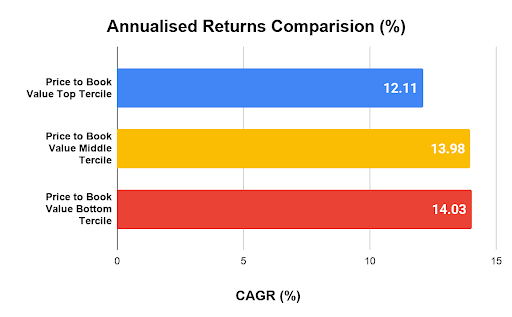
Source: Internal Research, CMIE, NJ AMC's Smartbeta Research Platform. Data is for the period 30th September 2006 to 30th April 2026. Price to Book Value Top, Middle, and Bottom Tercile Portfolios represent Top 33%, Middle 33% and Bottom 34% stocks respectively, based on the Price to Book Value parameter from Nifty 500 Universe. Past performance may or may not be sustained in the future and is not an indication of future return.
A few things stand out here:
- Stocks with higher P/B ratios outperformed during the period studied. The Bottom P/B Tercile (highest P/B stocks) delivered the highest annualised return of 14.03%, compared with 12.11% for the Top P/B Tercile (lowest P/B stocks).
- Higher P/B stocks also experienced lower volatility. The Bottom P/B Tercile recorded annualised volatility of 17.85%, versus 24.23% for the Top P/B Tercile.
- Risk-adjusted returns favoured higher P/B stocks. The Sharpe ratio was 0.37 for the Bottom P/B Tercile compared with 0.29 for the Top P/B Tercile.
- The gap in long-term performance is notable. Over rolling 5-year periods, the Bottom P/B Tercile generated a median return of 17.31%, nearly double the 8.87% generated by the Top P/B Tercile.
This highlights an important investing lesson. A low P/B ratio alone does not guarantee superior returns. Business quality, profitability, growth prospects, and other fundamentals can justify higher valuations and contribute to stronger long-term performance.
Industries Where P/B Ratio Works Best
P/B is most reliable in businesses where the balance sheet actually reflects what the company is worth.
-
Banking and Financial Services
This is where P/B gets used the most. A bank's core business is financial assets such as loans, deposits, and investments. Book value tells you a lot about the health of that business, which is why analysts rely heavily on P/B for relative valuation. Many also use Price-to-Tangible Book Value (P/TBV), which excludes goodwill and certain intangible assets.
-
Manufacturing and Capital-Intensive Industries
Factories, machinery, equipment. These are real, measurable assets. Book value is more grounded here than in, say, a consulting firm.
-
Real Estate and Infrastructure
Asset values are relatively transparent in these sectors. Investors are essentially asking: what is this physical asset worth, and am I paying a fair price for it?
-
NBFCs and Insurance Companies
Similar to banks. Asset quality and book value sit at the centre of how these businesses are valued. P/B is a standard part of the toolkit here.
Why P/B Ratio Doesn't Always Work
P/B ratio has one core problem. It only counts what's on the balance sheet. And a lot of what makes a business valuable never shows up there.
A software company's real assets are its code, its users, and its brand. None of that gets recorded as a tangible asset. So the book value looks thin, the P/B looks high, and a surface-level reading says the stock is expensive. It might not be.
Specific places it breaks down:
- Intangible-heavy businesses: Brand, patents, software, customer relationships. For many technology, pharmaceutical, and brand-driven consumer companies, P/B is often less informative than metrics such as P/E, EV/EBITDA, or free cash flow.
- Goodwill from acquisitions: Inflates book value. If the acquisition doesn't work out and goodwill gets written down, the P/B you were looking at was built on shaky ground.
- Historical cost problem: Assets sit on the books at what the company paid decades ago. Not what they're worth today. P/B just reports the old number.
- Loss-making companies: Every year of losses eats into book value. A low P/B here isn't undervaluation. The floor itself is shrinking.
- Heavy debt: Squeeze the equity base enough and P/B looks low. But that's financial risk, not hidden value.
P/B also says nothing about earnings power. A company can have solid book value and still be a poor investment if it generates weak returns on those assets. That's why it should never be the only number you look at.
Difference Between Cheap and Value Trap
This is probably the most important thing to understand about P/B. A stock can look cheap and keep getting cheaper. That's a value trap. The low ratio isn't hiding potential. It's reflecting a business that's genuinely in trouble.
A few things to check before concluding a low P/B is a bargain:
- Return on Equity (ROE): If the company can't generate decent returns on its own assets, why would the market pay up? A low P/B paired with a persistently low ROE is usually a red flag.
- Earnings trend: Is the business profitable? Growing? Or bleeding year after year?
- Debt levels: Heavy debt can make P/B look low. But if that debt is eating into earnings, the cheapness is misleading.
- Industry structure: A structurally declining sector will produce structurally low P/B stocks. That's not worth it. That's a slow exit.
- Management track record: Undervalued assets don't realise their value without someone capable running the business. Poor capital allocation destroys book value over time.
Cheap and undervalued are not the same thing. For the gap between price and book value to close, something has to change. P/B can't tell you whether that change is coming.
Factors to Evaluate Along with P/B
P/B on its own is a starting point, not a conclusion.
- Return on Equity (ROE): Measures how effectively a company generates profits from shareholders' equity. A high ROE often justifies a higher P/B ratio.
- Price-to-Earnings (P/E): Provides an earnings-based valuation perspective and helps determine whether a company that appears cheap on assets is also inexpensive relative to its profits.
- Debt-to-Equity (D/E): Assesses financial leverage and risk. High debt levels can make a stock's P/B ratio appear artificially low, potentially creating a misleading impression of value.
- EV/EBITDA: Offers a broader enterprise-level valuation by considering both debt and equity, making it particularly useful for comparing capital-intensive businesses.
- Price-to-Sales (P/S): Evaluates valuation relative to revenue and is especially helpful when earnings are temporarily depressed or inconsistent.
- Dividend Yield: Indicates the cash return provided to shareholders and can signal management's confidence in the company's financial strength and future prospects.
Key Takeaway: The most reliable value investing analysis combines multiple financial and valuation metrics rather than relying solely on the P/B ratio.
Conclusion
Back to the two shirts. The Rs. 2,000 one might be worth every rupee if the quality is genuinely better. The Rs. 1500 one might be exactly what it looks like. Price alone doesn't tell you which is which.
P/B ratio gives you a way to ask that question about a stock. It's not a perfect tool. It doesn't work the same way across every industry. A low number isn't automatically good news, and a high number isn't automatically bad. What you're really trying to figure out is whether the price reflects what the business is actually worth.
Investing isn't about finding the lowest price. It's about finding the best price for the right quality.
FAQs:
Q) Is a P/B ratio below 1 always a good buying opportunity?
Not necessarily. Trading below book value can indicate undervaluation, but it can equally mean the company is in trouble. Assets might be impaired, earnings might be declining, or the business model might be broken. Always look at ROE, earnings trend, and debt before drawing a conclusion.
Q) Can P/B ratio be negative? What does that mean?
Yes, though it's rare. It happens when liabilities exceed assets, giving the company negative shareholders' equity. That's usually a sign of serious financial distress. Not a value signal.
Q) What is the difference between P/B ratio and P/E ratio?
P/B compares the stock price to the company's net assets. P/E compares the stock price to its earnings. P/B is more relevant for asset-heavy businesses like banks. P/E is more widely used for companies where earnings are the main driver of value. Both together give a fuller picture.
SEBI Registered Name (Number): NJ Mutual Fund (MF/076/21/02) | Details of Other Regulatory Registrations: https://shorturl.at/SEBua
Investors are requested to take advice from their financial/ tax advisor before making an investment decision.
MUTUAL FUND INVESTMENTS ARE SUBJECT TO MARKET RISKS, READ ALL SCHEME RELATED DOCUMENTS CAREFULLY.
« Previous Next »