
Forensic & Governance Analysis: The Prerequisite of Quality Investing
Imagine you are house-hunting. You visit a beautiful property with freshly painted walls, clean floors, and bright lighting. The brochure ticks every box. But experienced buyers know that before signing anything, they call a structural engineer. Not to find the perfect house, but to rule out the dangerous ones. The cracked foundation hidden beneath polished tiles. The damp wall behind fresh paint. The faulty wiring concealed by a new switch panel.
Most investors approach the stock market the way an excited first-time buyer walks through a showroom apartment, dazzled by what they can see, blind to what lies beneath. They check earnings growth, brand recognition, and expanding margins. They run through standard financial ratios and feel confident. What they often miss is the structural inspection.
This is precisely where Forensic and Governance (F&G) analysis comes in. It is not a replacement for quality research; it is the structural report that every investor should demand before committing capital.
What Is Forensic and Governance Analysis?
Forensic and Governance analysis is the discipline of reading financial statements not just for what they say, but for what they might be hiding.
It has two distinct but complementary dimensions:
Forensic Analysis examines the quality and reliability of reported financial numbers. It asks:
- Are the profits being reported actually converting into cash in the bank?
- Are accounting choices being used aggressively to make results look better than they are?
- Is revenue being recognised prematurely?
- Are costs being capitalised instead of expensed?
- Is working capital being stretched to inflate short-term profitability?
Governance Analysis examines the behaviour and trustworthiness of the people managing the business. It asks:
- Are promoters pledging significant portions of their shareholding as collateral?
- Are related-party transactions unusually large or complex?
- Is there a pattern of auditor changes or rising audit fees?
- Are disclosures consistent, or do they become conveniently vague when circumstances worsen?
Together, these two lenses serve one purpose: identifying companies worth avoiding before the rest of the market reaches the same conclusion.
Why F&G Analysis Matters More Than Investors Think?
The honest answer is this: By the time problems become visible to the average investor, it is usually too late to exit cleanly.
Two concepts explain why F&G analysis is so powerful in identifying such risks before they crystallise:
Earnings Quality checks whether reported profits are converting into real, sustainable cash flows. A company can show impressive profits on its income statement while simultaneously burning through cash through aggressive revenue recognition, deferred expense tactics, or simply because the reported numbers do not reflect actual economic reality.
Reporting Quality examines whether the auditors overseeing the financial statements are independent enough to be believed. Frequent auditor changes, rising audit fees without clear justification, or auditors with limited capacity relative to the size and complexity of the company are all signals that the verification layer may be compromised.
Even businesses with genuinely impressive operations can fail both tests. Strong ROE is not a defence against hidden liabilities or compromised disclosures. The structural integrity matters as much as the surface performance.
Red Flags Every Investor Should Understand
F&G analysis is often dismissed as subjective. But many of the most important red flags can be measured, quantified, and screened systematically. Here are the key categories:
- Low OCF to EBITDA Ratio
Operating Cash Flow (OCF) to EBITDA is a direct measure of earnings quality. EBITDA measures profit before interest, tax, depreciation, and amortisation, a widely used profitability metric. But if cash generated from operations consistently falls far short of EBITDA, it signals that accounting choices, rather than real business performance, are driving the reported profit. The low OCF to EBITDA portfolio returned just 2.50% annually compared to Nifty 500 TRI’s 11.86% annually. - High Contingent Liabilities to Net Worth
Balance sheets carry footnotes about pending legal disputes, unresolved claims, and contingent obligations i.e. liabilities that may or may not crystallise depending on future events. When these contingent liabilities are large relative to a company's net worth, they represent a financial hazard that standard profitability metrics cannot capture. A high contingent liability portfolio returned just 9.28% annually meaningfully worse than the benchmark. - Promoter Pledge
When a promoter pledges shares as collateral for loans, the shares that are supposed to be held as a signal of confidence in the business become someone else's financial position. If the stock price falls, lenders can force the sale of pledged shares, pushing the price lower. As shown in the data below, a portfolio of high promoter pledge companies delivered an annualised return of just 3.87% compared to Nifty 500 TRI’s 11.86% annually.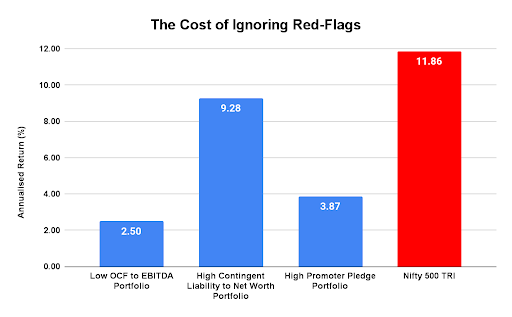 Source: NJ AMC's Internal Research, CMIE, NSE, NJ AMC's Proprietary SmartBeta Research Platform. Data is for the period 30th September 2009 to 20th March 2026. Low OCF to EBITDA Portfolio and High Contingent Liability to Net Worth Portfolio represent the bottom 50 stocks from the Nifty 500 universe based on respective parameters. High Promoter Pledge Portfolio represents stocks with more than 25% promoter pledge from the Nifty 500 universe. This data represents a back-tested simulation and does not represent the performance of any existing Mutual Fund scheme managed by NJ Asset Management Private Limited. Past performance may or may not be sustained and is not indicative of future returns.
F&G Analysis Does Not Promise Outperformance. It Promises Fewer Landmines.
This is the most important distinction to understand clearly. F&G analysis is not a strategy for finding multi-baggers. It is not a screen that identifies companies likely to generate extraordinary returns. Its purpose is different, and in many ways, more fundamental.
It reduces the probability of catastrophic loss.
Think of it this way: if you are building a portfolio of quality businesses and one of them turns out to be a fraud, or collapses under hidden leverage, or destroys value through governance failures, the damage to long-term compounding is disproportionate. A 70% loss in one position requires a 233% gain in another just to break even. Avoiding the landmines is not a conservative approach, it is a mathematically powerful one.
| Portfolio/Model | Sharpe Ratio | 3Y Loss Probability (%) | 5Y Median Rolling Returns (%) |
| NJ Quality+ Model | 0.57 | 1.03 | 19.76 |
| Top 80 Stocks as per F&G Ranking | 0.62 | 0.28 | 22.39 |
| Bottom 20 Stocks as per F&G Ranking | 0.38 | 14.73 | 9.73 |
Source: NJ AMC’s Internal Research, CMIE, NSE, NJ AMC’s Proprietary SmartBeta Research Platform. Data is for the period September 30, 2006 to March 31, 2026. Top 80 stocks and Bottom 20 stocks as per F&G ranking represent stocks ranked based on Forensic & Governance (F&G) parameters from NJ Quality+ Model. NJ Quality+ Model is a proprietary methodology developed by NJ Asset Management Private Limited. This data represents a back-tested simulation and does not represent the performance of any existing Mutual Fund scheme managed by NJ Asset Management Private Limited. Past performance may or may not be sustained and is not indicative of future returns.
Even within an already high-quality universe, F&G analysis adds meaningful separation. As evident in the table above, from a universe of 100 quality stocks, the bottom 20 ranked based on F&G parameters showed a loss probability of 14.73% and 5-year rolling returns of just 9.73% per annum. The top 80 stocks ranked based on F&G parameters showed a loss probability of just 0.28% and 5-year rolling returns of 22.39% per annum.
The lesson is clear: quality gets you into a good neighbourhood. Forensic and Governance analysis ensures you are not buying the house next to the crime scene.
F&G Analysis Is About Elimination, Not Just Selection
Most investment frameworks are built around the logic of selection which is to find the best businesses and own them. F&G analysis introduces a complementary and equally powerful logic: elimination.
This is the detective's method. Sherlock Holmes did not identify the culprit by guessing who seemed most suspicious. He eliminated every other possibility until only the truth remained. F&G analysis applies exactly this logic to portfolio construction. Systematically remove companies with structural weaknesses, governance concerns, and earnings quality problems, and the remaining universe becomes meaningfully safer to evaluate.
Conclusion
Remember the house-hunting analogy from the beginning. The structural engineer does not tell you which house to buy. They tell you which ones to walk away from before you have already paid the deposit.
F&G analysis plays exactly the same role in portfolio construction. It is not the whole story, but it is the layer of the story that most investors skip, and that skipping is precisely where capital is permanently lost. In a world where financial statements can be dressed up, disclosures can be selectively vague, and governance failures can stay hidden for years, the ability to read between the lines is not an optional skill. It is a form of investor self-protection.
The best investment decisions are not just about finding the right answer, they are about eliminating the wrong ones first.
FAQs
Q) Is F&G analysis only relevant for small or mid-cap stocks?
Not at all. While governance failures may appear more frequently among smaller companies with less regulatory scrutiny, large-cap companies have also been subject to significant forensic concerns like Satyam Computers being a prominent example. F&G analysis is relevant across market caps and should be applied consistently regardless of company size or index membership.
Q) Is forensic analysis the same as looking for accounting fraud?
Not exactly. Forensic analysis looks for a broader spectrum of earnings quality concerns from outright fraud to aggressive-but-legal accounting choices that inflate reported profits beyond their economic reality.
Q) How does F&G analysis fit alongside quality factor investing?
F&G analysis is best understood as a second layer applied within a quality investing framework. F&G analysis then ensures that the reported quality is real and that the governance environment is trustworthy. Together, they offer a more complete view of investment risk than either lens alone.
Investors are requested to take advice from their financial/ tax advisor before making an investment decision.
MUTUAL FUND INVESTMENTS ARE SUBJECT TO MARKET RISKS, READ ALL SCHEME RELATED DOCUMENTS CAREFULLY.
SEBI Registered Name (Number): NJ Mutual Fund (MF/076/21/02)
Details of Other Regulatory Registrations : https://shorturl.at/eJgJt