
Value Investing Simplified: What is the P/E Ratio?
Imagine you are at a busy street market buying fruits. Two shops are selling apples that look almost the same. One shop is charging a modest price, while the other is asking for much more. At first glance, the expensive one may seem better. But a careful buyer pauses and asks a smarter question: Am I paying the right price for what I am getting? In many ways, that is what value investing is all about.
That is exactly how investing works. A stock’s market price alone does not tell you whether it is cheap, expensive, or fairly valued. For that, investors use valuation tools. One of the most common and widely used starting points is the P/E Ratio, or Price-to-Earnings Ratio. In value investing, it works like a first filter. It may not tell the whole story, but it helps investors begin with the right question: how much am I paying for a company’s earnings?
What is PE in simple words?
The P/E Ratio tells you how much investors are willing to pay for every ₹1 of a company’s earnings. In simple terms, it compares a company’s stock price with the profit it generates per share.
The formula is:
P/E Ratio = Market Price Per Share ÷ Earnings Per Share (EPS)
Suppose a company’s share price is ₹200 and its earnings per share are ₹20. The P/E Ratio will be 10. This means investors are paying ₹10 for every ₹1 of earnings the company generates.
That is why the P/E Ratio is often seen as a quick valuation tool. It helps investors move beyond price and start looking at value. In fact, P/E is one of the key traditional value parameters used to assess whether a stock appears undervalued relative to its earnings, alongside measures like dividend yield and price-to-book value.
Interpretation:
The formula may look simple, but its interpretation matters even more.
A low P/E Ratio usually suggests that the stock is priced lower compared to its earnings. This may attract value investors who are searching for potential bargains.
A high P/E Ratio usually suggests that investors are willing to pay a premium for the stock, often because they expect strong growth in the future.
For example, if Company A trades at a P/E of 10 and Company B trades at a P/E of 25, it does not automatically mean Company A is better. It simply means the market is paying less for Company A’s current earnings and more for Company B’s. The reason could be growth expectations, business quality, risk, sentiment, or all of these together.
So, the P/E Ratio is not a verdict. It is a clue.
Why does PE matter to investors?
The P/E Ratio matters because it gives investors a starting point to understand stock valuation. In value investing, the idea is not just to buy a good company. It is to buy a good quality company at a reasonable price.
Think of it like buying a house. A beautiful house may still be a poor deal if the price is too high. In the same way, a strong business may not always be a good investment if the market is already pricing in too much optimism.
The P/E Ratio helps investors bring discipline into decision-making. It encourages them to ask whether they are paying too much for current earnings, or whether a stock may be available at a more reasonable valuation. It is one of the simplest ways to connect price with profits, which is why it remains an important part of value investing.
Why do investors get attracted to low PE stocks?
Investors often get drawn to low P/E stocks because they appear cheaper relative to earnings. For value-focused investors, that can feel like finding a good product at a discount.
The appeal is easy to understand. If two companies are earning similar profits, but one trades at a much lower P/E, it may look more attractive. Many investors see this as an opportunity to buy before the broader market recognizes the stock’s true worth.
There is also a practical reason for this attraction. Historically, value-oriented investing has focused on stocks priced below their intrinsic worth, and P/E has long been one of the tools used to identify such opportunities.
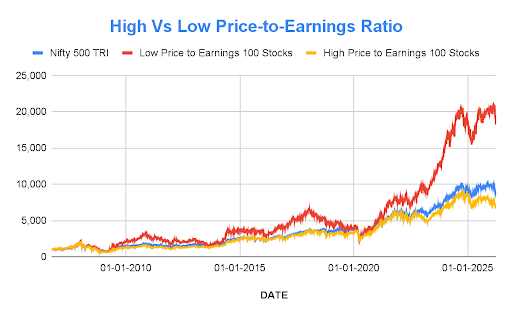
| From Sep 2006 to March 2026 | CAGR (%) | 10 Year Median Rolling Returns (%) | Annualised Volatility (%) | Maximum Drawdown (%) | Cumulative Growth of ₹1,000 |
| Low Price to Earnings 100 Stocks | 16.03 | 15.23 | 23.46 | -69.68 | ₹18,202 |
| High Price to Earnings 100 Stocks | 10.25 | 12.73 | 19.31 | -72.30 | ₹6,710 |
| Nifty 500 TRI | 11.63 | 13.64 | 19.88 | -63.71 | ₹8,537 |
Source: CMIE, NJ’s Smart Beta Platform. Data is for the period 30th September 2006 to 31st March 2026. Companies with negative earnings are not considered. Past performance may or may not be sustained in future and is not indication of future return.
A long-term chart comparison between Low PE 100, High PE 100, and Nifty 500 TRI adds useful context here. The chart shows that over the period displayed, the Low PE 100 basket has meaningfully outperformed both the High PE 100 basket and the Nifty 500 TRI. This reinforces an important point: valuation can influence long-term outcomes, and paying a lower multiple for earnings has often worked well as a broad strategy over time.
At the same time, investors should treat this as a pattern, not a shortcut. A low P/E basket may outperform over long periods, but stock selection still matters.
Is a Low P/E a good thing?
Not always.
A low P/E can indicate an opportunity, but it can also be a warning sign. Sometimes a stock looks cheap because the market is worried about the business. There may be concerns around weak growth, falling earnings, rising debt, poor management decisions, or industry-specific risks.
This is where many investors fall into a value trap. A stock may look attractive on valuation, but if the business fundamentals are deteriorating, the low P/E may simply be reflecting that weakness.
That is why value investing should never stop at the first number. A low P/E only becomes meaningful when supported by healthy fundamentals, sustainable earnings, and reasonable prospects.
Can a high PE still make sense?
Yes, it can.
A high P/E stock may look expensive on the surface, but sometimes the market is willing to pay more because it expects the company’s earnings to grow strongly in the future. In such cases, the stock may be priced in future potential rather than just current profits.
This is common in businesses that have strong growth runways, competitive advantages, scalable models, or leadership positions in their sectors. A higher multiple may reflect confidence that tomorrow’s earnings will be much bigger than today’s.
Still, investors need balance. A high P/E can make sense, but only when business quality and growth justify the premium. If expectations become too optimistic and the company fails to deliver, the stock can correct sharply.
So, just as a low P/E should not automatically be seen as good, a high P/E should not automatically be seen as bad.
How should PE be used in value investing?
In value investing, the P/E Ratio should be used as a starting tool, not the final decision-maker.
It helps investors shortlist companies that may deserve closer attention. But after that, deeper analysis becomes necessary. Investors should study whether earnings are stable, whether the company has a strong balance sheet, whether growth is durable, and whether the business has the quality to create value over time.
But even then, the lesson is not to buy the lowest P/E stock that investors find. The better lesson is this: use P/E to ask better questions. Compare a stock’s P/E with its own history, with peers in the same sector, and with the broader market. Then, examine whether the lower or higher valuation is actually justified.
That is how the P/E Ratio becomes useful in value investing. It moves from being just a number to becoming part of a broader valuation framework.
What mistakes should investors avoid when looking at PE?
One of the biggest mistakes is assuming that a lower P/E always means a better stock. It does not. Cheap stocks can stay cheap for good reasons.
Another mistake is comparing P/E Ratios across unrelated industries. Different sectors have different growth rates, risk levels, and capital structures, so their valuation ranges can vary widely.
Investors should also avoid using the P/E Ratio in isolation. Earnings may be cyclical, temporarily inflated, or under pressure. If the quality of earnings is poor, the P/E Ratio can give a misleading impression.
A further mistake is ignoring the business itself. A stock is not just a number on a screen. Behind every P/E Ratio is a company with management, products, customers, risks, and opportunities. If those factors are weak, the valuation alone cannot save the investment thesis.
Conclusion
Just like the mango in the market, a stock’s price by itself tells you very little. The real question is whether the price matches the quality and value of what you are getting. That is where the P/E Ratio becomes useful. It helps investors move beyond the surface and start thinking in terms of valuation, not just price.
In value investing, the P/E ratio is like the first glance before making a thoughtful purchase. It can help spot opportunities, highlight caution, and bring discipline to decision-making. But it works best when paired with common sense, context, and deeper analysis. Because in investing, as in the market, the smartest buyer is not the one who picks the cheapest-looking option, but the one who understands what is truly worth paying for.
FAQs
Q) Does a low P/E Ratio always mean a stock is undervalued?
No. A low P/E may indicate undervaluation, but it may also reflect weak business fundamentals, low growth, or market concerns about the company.
Q) Should investors rely only on the P/E Ratio?
No. The P/E Ratio is only a starting point. Investors should also look at earnings quality, debt levels, growth prospects, cash flows, and overall business strength.
Q) How should P/E be used in value investing?
It should be used as an initial valuation filter. Investors can use it to compare stocks, but the final investment decision should always include deeper fundamental analysis.
Investors are requested to take advice from their financial/ tax advisor before making an investment decision.
MUTUAL FUND INVESTMENTS ARE SUBJECT TO MARKET RISKS, READ ALL SCHEME RELATED DOCUMENTS CAREFULLY.
« Previous Next »