
Quality Investing Simplified: What is ROE and Why Does It Matter?
Imagine you’re buying a car. Two models look equally stylish, both have fancy features, and both claim great performance. But you ask one simple question: kitna deti hai? Because mileage quietly tells you how efficiently the car converts fuel into distance.
What is ROE?
ROE stands for Return on Equity. It is a financial metric that indicates the amount of profit a company generates using the money invested by its shareholders.
Shareholders’ equity broadly represents the company’s net worth from an accounting perspective (i.e., assets minus liabilities). ROE, therefore, reflects how much return is earned by investors on that net worth.
Formula
ROE = (Net Profit / Shareholders’ Equity) × 100
Example
Suppose ABC Company earns ₹50 crore in net profit and has ₹500 crore in shareholders’ equity:
ROE = (₹50 / ₹500) × 100 = 10%
This means the ABC Company generated a 10% return on shareholders’ equity during that period, which is roughly ₹0.10 (10 paise) of profit per ₹1 of equity.
Why ROE is Useful for Judging Profitability
Investors and analysts widely use ROE because it highlights how productive equity capital is. A consistently strong ROE may indicate:
1) Efficient capital use
A company producing strong profits without requiring a proportional increase in equity capital can signal operational efficiency. Weak ROE, on the other hand, can reflect poor profitability, inefficient deployment of funds, or challenging business economics.
2) A strong business model
Higher ROE businesses often have strong pricing power, differentiated products, cost advantages, or scalable models, especially if the returns are achieved without excessive leverage.
3) Better potential for compounding
When profits are reinvested at high rates of return, shareholder wealth can compound faster over time. Companies that reinvest profitably may not need to pay very high dividends to create value, because retained earnings can generate attractive incremental returns. In that sense, ROE becomes a useful companion: it reveals the productivity of equity capital, which is a meaningful marker of durable business strength.
Can ROE be Used as a Quality Indicator?
Quality stocks are often associated with characteristics such as healthy cash flows, reasonable leverage, consistent growth, and efficient capital allocation. ROE directly relates to this last trait, which is efficient use of equity capital, but it works best when interpreted with context.
But investors should remember that for any company, a one-time profit surge can temporarily inflate ROE. Hence, rather than looking at a single-year ROE, a multi-year view helps investors judge whether returns are stable and repeatable, rather than accidental or cyclical.
Does ROE Deliver?
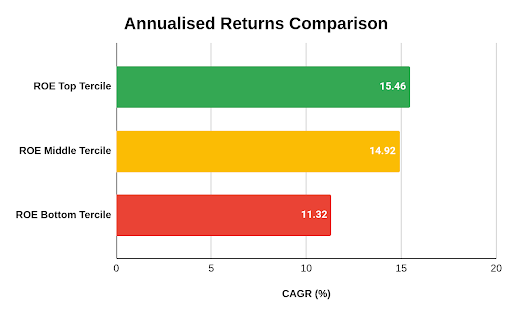
To assess the effectiveness of ROE as a metric, all stocks of the Nifty 500 index were segmented into equal terciles (3 parts) for the period 30 September 2006 to 30 November 2025 based on Return on Equity (ROE). The highest ROE comprised the first segment, and the lowest ROE comprised the last segment. Portfolios were rebalanced on a half-yearly basis. The results:
| Portfolio | Annualised Sharpe Ratio | Annualised Volatility (%) | Maximum Drawdown (%) | Median Rolling Return (%) | |||
| 1-Year | 3-Year | 5-Year | 10-Year | ||||
| ROE Top Tercile | 0.42 | 17.63 | -64.62 | 12.71 | 16.93 | 16.86 | 16.73 |
| ROE Middle Tercile | 0.38 | 20.66 | -71.44 | 10.11 | 17.04 | 14.1 | 14.79 |
| ROE Bottom Tercile | 0.27 | 23.45 | -75.18 | 6.62 | 13.84 | 8.76 | 10.87 |
Source: Internal Research, CMIE, NJ AMC's Smartbeta Research Platform. Data is for the period 30th September 2006 to 30th November 2025. ROE Top, Middle, and Bottom Tercile Portfolios represent Top 33%, Middle 33% and Bottom 34% stocks respectively, based on the ROE parameter from Nifty 500 Universe. Past performance may or may not be sustained in the future and is not an indication of future return.
The data shows that higher-ROE companies delivered both better returns and smoother risk. The Top ROE tercile exhibited the best risk-adjusted performance (Sharpe ratio of 0.42) with lower volatility (17.63%) and smaller drawdowns (-64.62%) compared to the Bottom tercile (Sharpe ratio of 0.27, volatility of 23.45%, drawdown of -75.18%), suggesting a clear historical ROE premium.
When High ROE Can Be a Trap
Here’s the twist: a high ROE can sometimes be a mirage. Just like mileage quietly tells you how efficiently a car converts fuel into distance, ROE is meant to signal how efficiently a company converts equity into profits. But an impressive ROE can be boosted by factors that don’t reflect real business quality—so it’s important to check what’s actually driving it under the hood.
Common ROE traps
1) High debt artificially boosts ROE
Excessive borrowing can reduce the equity base and raise ROE mechanically. While the ROE looks attractive, the business may be taking on higher financial risk, especially if cash flows are not stable.
2) One-time or extraordinary profits
Asset sales, revaluation gains, or exceptional items can temporarily lift net profit and ROE. Investors often benefit from checking whether profits are operational or other income-driven.
3) Shrinking equity base
Buybacks can boost ROE (sometimes positively, sometimes artificially). Accumulated losses can also shrink equity, making ROE look high even if the business isn’t genuinely strong. A high ROE driven by a weakening equity base deserves extra scrutiny.
The key is not just to see what the ROE is, but why it is high.
Conclusion
Coming back to the car analogy, mileage doesn’t tell you everything. It won’t tell you the comfort, safety, or long-term maintenance costs. But it does reveal something fundamental: how efficiently the machine uses what it’s given.
ROE behaves similarly. It won’t single-handedly guarantee complete quality, but it’s a powerful tool to measure efficiency and profitability, two important pillars of quality investing. When investors start tracking ROE, they stop judging businesses by noise and start judging them by capability.
Because in the long run, wealth is often built by businesses that don’t just look good, but also perform efficiently, year after year.
FAQs
Q) What is a good ROE for a company?
ROE that is above the industry average and remains consistent over time is generally viewed positively. In many sectors, an ROE above ~15% may be considered healthy, but peer comparison and stability are more important than a fixed threshold.
Q) Can ROE be negative?
Yes. ROE can be negative if a company has a net loss (negative profit). ROE can also behave unusually if equity is very low or negative, which typically signals financial stress.
Q) Is a higher ROE always better?
Not necessarily. Extremely high ROE may be driven by high debt, one-time gains, or a shrinking equity base. Investors often review the underlying drivers before treating high ROE as a sign of strength.
Investors are requested to take advice from their financial/ tax advisor before making an investment decision.
MUTUAL FUND INVESTMENTS ARE SUBJECT TO MARKET RISKS. READ ALL SCHEME RELATED DOCUMENTS CAREFULLY.
« Previous Next »