
Momentum investing: Why winning stocks need strict rules
Momentum is one of the more awkward ideas in investing. The FIFA World Cup offers a useful way to think about it.
A team that starts a tournament well often looks different by the third match: the passing is quicker, the players trust each other’s runs and the crowd starts to expect another good performance. Commentators may say the team has found its rhythm but none of this guarantees that it will win the next match. A red card, an injury or a stronger opponent can break the run. Yet recent form still tells us something useful.
Momentum investing rests on a similar observation. Recent strength can persist for a while, because confidence, attention and expectations often adjust gradually. In markets, the same pattern appears through prices, earnings expectations and capital flows.
That delay creates the momentum factor. Stocks that have performed well in the recent past may continue to perform well for a while longer. Although, do keep in mind that the phrase "for a while" does a lot of work. That’s because momentum is about persistence; it is never a claim of permanence.
The danger lies in taking the analogy too far. A team in form is not unbeatable. Similarly, a stock with momentum is not automatically sound. The discipline is in measuring the signal, testing it across market conditions and refusing to confuse a strong run with a permanent state.
This is why the momentum factor attracts both serious research and careless imitation. While the research studies measurable signals, the imitation buys what has gone up and hopes the trend continues. The gap between the two is where most investor damage occurs.
A brief word on factor investing
Before we delve deeper into the momentum factor, let’s take a quick look at factor investing. Factor investing studies characteristics that have historically helped explain the behaviour (such as return and drawdowns) of securities (such as stocks). The value factor focuses on price relative to fundamentals. The quality factor studies a company’s financial strength. The low volatility factor examines price behaviour during market swings. And finally, the momentum factor studies relative price strength.
Importantly, a factor is useful only if it can be defined in advance, tested over long periods and implemented consistently. Otherwise, it becomes a story attached to a portfolio after the fact.
Momentum factor passes the first test because it can be measured. The usual inputs are price returns over a defined period, such as six or 12 months. More refined models may adjust the signal for volatility or examine earnings momentum. But the common thread is simple: the process ranks stocks by evidence of recent strength.
What is the momentum factor?
The football comparison also helps clarify what momentum is measuring. A serious pundit would not judge a team only by one spectacular goal. They would look at whether the improvement is visible across matches, whether the defence is holding up, whether the midfield is controlling play and whether the performance survives pressure.
Momentum investing requires the same caution because a single sharp price rise is insufficient evidence. A better process looks for persistence over a defined period, adjusts for volatility and checks whether the business has enough quality to support the signal. Recent strength matters only when it survives scrutiny.
Why momentum can work
The common explanation for momentum is circular: prices rise because prices have risen. That is not a satisfactory explanation. It describes the pattern but says little about the cause.
A better answer lies in slow belief revision. That is because investors anchor to old views, analysts gradually raise earnings estimates and institutions build positions over time. The reason this revision process is slow is that many market participants prefer confirmation to early action. So, when facts improve, the market may respond in stages.
However, the same delay can work in reverse. Weak companies may continue to underperform because investors are often reluctant to accept that the original investment thesis is no longer valid. Thus, negative information or bad news may also take considerable time before it is fully reflected in prices.
Momentum is therefore rooted in behaviour as much as in data. The market may be efficient over long periods, but the path to that efficiency can be untidy. The momentum factor attempts to capture that path.
Price strength is a signal, not a verdict
A rising price can mean several things. Sometimes it reflects improving business fundamentals. Sometimes it reflects temporary enthusiasm. And sometimes it may reflect liquidity moving into a narrow part of the market.
A rule-based momentum process must make a clear distinction between these cases. Raw price momentum is a useful starting point because it is clean and observable. But it is also blunt. A stock can rank well on recent performance even when its balance sheet is strained or its earnings quality is poor.
This is the first serious caution in momentum investing. Price strength can identify an opportunity but it can also disguise fragility.
How momentum investing is implemented
A disciplined momentum strategy starts by deciding which stocks to consider. It measures recent strength using set rules, ranks the stocks, builds the portfolio based on those rankings, and rebalances at regular intervals.
How you design the strategy matters. If you look back over too short a period, you might catch random moves. If you look back too long, you might react too slowly. Using just price can find big winners, but it can also lead to unstable stocks being considered. Adjusting for volatility can highlight steadier trends. Checking earnings momentum can show if price moves are backed by real business results.
Given these challenges, a good process recognises that no single signal deserves blind trust. Momentum becomes more credible when price evidence is checked against risk and quality filters.
The main types of momentum
Needless to say, price momentum is the well-known type of momentum in the whole bunch. It ranks stocks by recent price performance.
Risk-adjusted momentum considers how that performance was achieved. A stock that rises steadily may carry a different risk profile from one that rises through violent swings.
Alpha-based momentum tries to isolate stock-specific strength after accounting for market exposure. This can help reduce the chance of mistaking a broad market rally for company-level strength.
Earnings momentum examines the improvement in profits or earnings expectations. It is slower than price momentum, but often more closely tied to business reality.
These distinctions matter because momentum is often discussed as if it were one uniform idea. In practice, construction determines experience. For instance, a strategy based solely on price momentum may concentrate on stocks that have appreciated most rapidly, while a risk-adjusted momentum approach might instead emphasise stocks that have achieved consistent gains with lower volatility. In fact, two strategies may both be labelled as ‘momentum,’ yet their specific selection criteria and risk profiles can result in markedly different investment outcomes.
Momentum investing in India
India offers a fertile setting for momentum because information is unevenly distributed. Large companies are closely watched. Smaller and mid-sized companies often receive thinner coverage. In those parts of the market, new information may take longer to be reflected in prices.
This does not make the Indian market inefficient in a casual sense. It means the speed of adjustment varies across companies and that variation is exactly what a systematic factor process can study.
According to our own research, the Nifty 500 Momentum 50 TRI has achieved a significant long-term excess return relative to the broader Nifty 500 TRI during the period from April 2005 to March 2026. However, the same research demonstrates that this outperformance came with greater downside risk, as the momentum index experienced more pronounced drawdowns compared to the overall market index.
Momentum leads, at a price
Its higher long-term return comes with the deepest drawdown among the factors shown
| Index | Annualised return (%) | Annualised volatility (%) | Sharpe ratio | Maximum drawdown (%) | 5Y loss probability (%) | 5-year median rolling return (% pa) | 10-year median rolling return (% pa) |
| NIFTY 500 VALUE 50 TRI | 16.62 | 25.56 | 0.42 | -66.06 | 3.65 | 14.28 | 14.75 |
| NIFTY500 MOMENTUM 50 TRI | 21.08 | 22.32 | 0.61 | -70.24 | 1.66 | 21.95 | 20.10 |
| NIFTY500 LOW VOLATILITY 50 TRI | 17.22 | 16.03 | 0.60 | -48.26 | 0.00 | 15.83 | 15.43 |
| NIFTY500 QUALITY 50 TRI | 16.26 | 18.11 | 0.52 | -53.60 | 0.03 | 16.77 | 16.15 |
| NIFTY500 MULTIFACTOR MQVLV 50 TRI | 19.43 | 17.21 | 0.64 | -53.93 | 0.00 | 19.24 | 18.49 |
| Nifty 500 TRI | 11.63 | 19.88 | 0.28 | -63.71 | 1.11 | 13.62 | 13.30 |
Source: NSE, CMIE, NJ Asset Management Private Limited Internal Research, NJ’s Smart Beta Platform (in-house proprietary model of NJAMC). Calculations are for the period April 01, 2005 to March 31, 2026. This data represents a back-tested simulation and does not represent the performance of any existing mutual fund scheme managed by NJ Asset Management Private Limited. Past performance may or may not be sustained in future and is not an indication of future return.
That combination should shape the investor’s expectations. While momentum has been powerful in Indian equities, it has also been uncomfortable.
Apart from the market-beating returns, the momentum factor has also seen a remarkable increase in both demand and supply. In March 2020, momentum AUM in Indian mutual funds was effectively zero. However, by March 2026, it had grown to roughly Rs 28,648 crore across 53 schemes.

Source: ICRA, NJ AMC's Internal Research. All Passive and Active Smartbeta Funds are considered. Momentum-oriented refers to those funds that focus on the momentum factor alone as well as combined with other factors. Past data may or may not be sustained in the future.
Three forces have driven this growth:
- Improved product availability under SEBI's smart-beta framework.
- Rising investor awareness of factor investing as a third option alongside active and passive.
- Strong recent performance of momentum in Indian equities, which has pulled capital toward the factor.
The benefit: exposure to persistence
Momentum investing helps investors participate in trends that are already visible but not fully exhausted. This is valuable because markets often reward improving facts before they become universally accepted.
The factor can also behave differently from value, quality, or low volatility. For example, consider an investor holding a portfolio diversified across these factors: if market sentiment shifts rapidly due to new industry data, value stocks might lag as their appeal is recognised only after sustained positive evidence, while momentum stocks could respond swiftly to the new trend. Similarly, during volatile market periods, a low volatility strategy might prioritise incremental and steady gains, whereas a momentum strategy might willingly accept larger short-term fluctuations to capture ongoing trends. These distinctions make momentum potentially useful within a broader factor allocation by providing exposure to return patterns that differ from (and may complement) those of value and low-volatility strategies.
Having said that, no investor should confuse this with a promise. A historically strong factor can underperform for long stretches. Momentum’s benefit is the possibility of capturing persistence. But its underlying condition is patience.
The risk: reversals can be brutal
Momentum carries an obvious danger: a trend that persists can also break.
When the turn comes, recent winners may fall quickly and crowded trades can unwind without much mercy. Market leadership can change when interest rates, liquidity or earnings expectations shift. Thus, the same mechanism that attracts capital to winners can push it out just as forcefully.
Moreover, the behavioural risk may be larger than the market risk. A football team that looked fluent in the group stage can look ordinary in a knockout match once the opponent changes the tempo. Similarly, a stock that looked strong in one environment can weaken sharply when liquidity tightens, earnings disappoint or sector leadership shifts.
This is why momentum needs humility. The signal is useful because trends can persist. At the same time, the risk is real because trends can end abruptly.
Investors often discover momentum after a period of strong performance. They enter with fresh confidence and little memory of the last drawdown. When underperformance arrives, the factor feels defective. And exiting at that point converts temporary discomfort into a permanent mistake.
A momentum investor, therefore, needs a more honest question than "has the factor worked?" The useful question is whether the investor can hold it when it stops working for a while.
How rule-based investing deals with momentum
Momentum is too emotionally charged to be handled casually. It rewards strength, which makes it attractive after good periods. Simultaneously, it suffers reversals, which makes it hard to hold during bad periods. So it is easy to see why a discretionary response to such a factor can easily become a buy-high, sell-low habit.
Enter rule-based investing.
A rule-based process is a pre-commitment. The rules decide the universe, the measurement period, the ranking method, the filters and the rebalance schedule before market emotion intervenes. Once set, the process does not change because a recent winner has become popular or a recent loser has become embarrassing.
This is where NJ Mutual Fund’s investment philosophy becomes relevant. NJ Mutual Fund follows a 100% rule-based approach. In a momentum fund, that matters because price strength alone is insufficient. The process must also control for companies whose momentum is unsupported by financial quality or governance comfort.
Quality filtration changes the character of the fund. It seeks to remove low-quality companies before momentum selection begins. That does not eliminate risk, but it does reduce the chance that a portfolio owns stocks whose only merit is recent price movement.
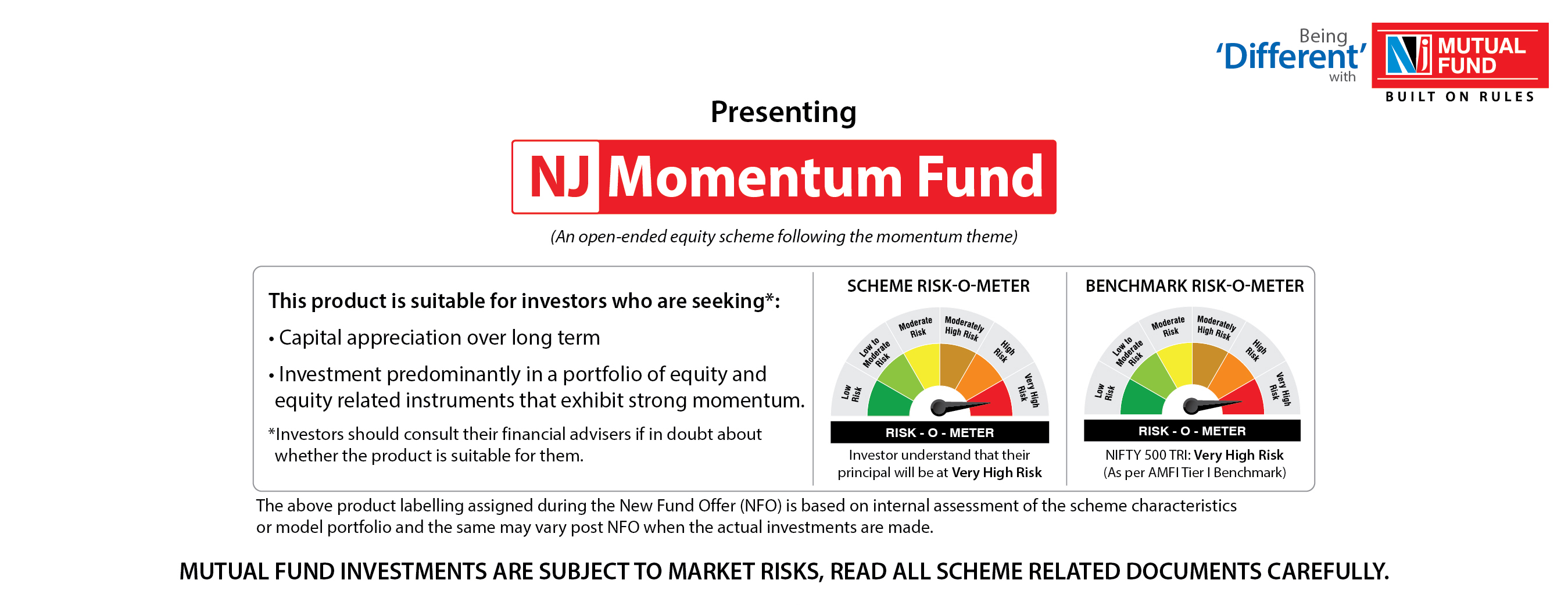
This is precisely how our NJ Momentum Fund* works. We call it Quality ke saath Momentum.
Who should consider momentum investing?
Momentum investing suits investors who can accept equity volatility and remain invested through periods of underperformance. A long investment horizon, typically five years or more, is essential. The factor’s return pattern can be lumpy and the difficult years are part of the experience.
It is less suitable for investors who need stability, have a short investment horizon or are likely to exit after a sharp fall. It is also unsuitable for investors drawn to the factor mainly because recent returns look attractive.
Suitability matters because we believe momentum does not usually fail investors through complexity. Rather, it fails them through their own behaviour.
Conclusion
Momentum investing begins with a simple observation: markets often recognise change gradually. That observation has produced a well-documented factor.
But don’t let that simplicity fool you. A rising stock is not automatically a good investment, and a strong factor record is not automatically a good investor experience. This is where our 100% rule-based process makes hay because the factor itself invites poor behaviour.
The sensible case for momentum investing is therefore not excitement about recent winners. It is the use of a disciplined process to study persistence, exclude weak candidates and rebalance without emotion.
FAQs:
Q) What is the momentum factor?
The momentum factor is a measurable characteristic that ranks securities by recent price or earnings strength. It is one of the commonly studied factors in equity investing.
Q) What are the main types of momentum?
The main types include price momentum, risk-adjusted momentum, alpha-based momentum and earnings momentum. Each measures strength differently.
Q) What are the risks of momentum investing?
The main risks include sharp reversals, high volatility, underperformance during market turns and the possibility of entering after a strong run. Investor behaviour is a major risk.
Q) How does rule-based investing help in momentum strategies?
Rule-based investing defines the process in advance. It helps measure signals consistently, apply filters systematically and rebalance without emotional intervention.
*NJ Momentum Fund is an open-ended equity scheme following the momentum theme. Its New Fund Offer opened on July 10, 2026 and closed on July 24, 2026. The Scheme opens for subscription on August 3, 2026. As the Scheme is newly launched and has not completed six months from its date of allotment/inception, it does not have a performance track record eligible for disclosure. Accordingly, returns for the Regular Plan and Direct Plan over the 1-year, 3-year, 5-year and since-inception periods, along with the corresponding value of a ₹10,000 investment, are not available and have not been disclosed. Any performance figures appearing in this article relate solely to the stated market indices, factor indices or back-tested research and do not represent the actual or indicative performance of NJ Momentum Fund.
SEBI Registered Name (Number): NJ Mutual Fund (MF/076/21/02) | Details of Other Regulatory Registrations: https://shorturl.at/SEBua
Investors are requested to take advice from their financial/ tax advisor before making an investment decision.
MUTUAL FUND INVESTMENTS ARE SUBJECT TO MARKET RISKS, READ ALL SCHEME RELATED DOCUMENTS CAREFULLY.
« Previous Next »