
Value Investing Simplified: What is Dividend Yield?
Introduction
Picture two rental properties in the same neighbourhood. Both cost ₹50 lakh. The first brings in ₹3 lakh in rent every year. The second? Just ₹1 lakh. On paper, they look identical, same price, same locality. But any sensible landlord knows which one is the better deal. The income changes everything. This is the foundation of value investing.
Stocks work the same way, and yet most investors barely look at income. They watch prices go up and down, cheer when a stock rallies, panic when it falls. What they miss is a quieter, steadier signal hiding in plain sight: the money a company actually pays its shareholders, year after year. That, measured against what you paid, is dividend yield. And honestly, for value investors, it's one of the most reliable compasses out there.
In this blog, you will learn:
- What dividend yield means, in simple language
- How to calculate it quickly and correctly
- What it reveals about a company's financial health
- Where it can mislead you, and how to avoid those traps
- How to use it as a thinking tool, not just a number
Looking Beyond Price: Why Income Matters
Here's the thing, price alone tells you almost nothing.
A stock at ₹100 could be expensive if the company earns very little. A stock at ₹1,000 could be a genuine bargain if it generates strong cash and consistently returns it to shareholders. Price is just what you pay. What you get back is a different question entirely.
That's where dividends come in. When a company pays a regular dividend, it's quietly signalling three things:
- It generates real cash profits, not just accounting profits
- Management is willing to share those profits with shareholders
- The business is stable enough to commit to regular payouts
For a value investor, that combination of discipline and shareholder-friendliness is exactly what they look for.
Dividend Yield Explained Without the Jargon
Dividend yield is simply a ratio, how much annual income you receive relative to what you paid for the stock.
The formula:
Dividend Yield (%) = (Annual Dividend Per Share ÷ Current Market Price Per Share) × 100
A quick example: A company pays ₹10 per share as annual dividend. Its stock price is ₹200.
(10 ÷ 200) × 100 = 5%
So for every ₹100 invested, you get ₹5 back every year, regardless of whether the price moves.
Now here's where it gets interesting. If the stock price falls to ₹100, that same ₹10 dividend gives a yield of 10%. If the price rises to ₹400, the yield drops to 2.5%.
Price and yield move in opposite directions. Always. And that inverse relationship is at the heart of value investing, when quality stocks get cheap, their yield rises, quietly flashing a signal to patient investors who are paying attention.
Why Value Investors Pay Attention to Dividend Yield
Value investors are bargain hunters at heart. They want to pay less than what something is worth, and dividend yield helps them spot exactly that.
So what does it actually tell you? Quite a bit:
- It's grounded in reality. Dividends are real cash paid out, not projections, not estimates. They're much harder to manipulate than earnings forecasts.
- It finds the overlooked ones. Stocks with consistently high yields often sit in corners of the market that everyone's ignoring. That's usually where value hides.
- It pays you to wait. While the market takes its time recognising a stock's true worth, the dividend keeps coming in. Every quarter. Whether the market agrees with you or not.
- It signals confidence. A company that holds or grows its dividend through a rough patch is essentially saying, we believe in our own stability. That's a meaningful statement.
What the Data Shows:
| Portfolio | Annualised Return (%) | Annualised Sharpe Ratio | Annualised Volatility (%) | Maximum Drawdown (%) | Median Rolling Return (%) | |||
| 1-Year | 3-Year | 5-Year | 10-Year | |||||
| Dividend Yield Top Tercile | 18.49 | 0.48 | 20.16 | -65.32 | 13.97 | 22.07 | 18.21 | 19.15 |
| Dividend Yield Middle Tercile | 14.84 | 0.38 | 19.57 | -69.82 | 11.9 | 17.57 | 16.53 | 16.54 |
| Dividend Yield Bottom Tercile | 7.44 | 0.14 | 22.06 | -76.59 | 3.17 | 8.8 | 6.67 | 7.44 |
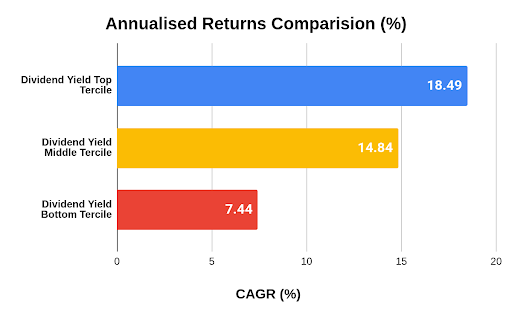
Source: Internal Research, CMIE, NJ AMC's Smartbeta Research Platform. Data is for the period 30th September 2006 to 31st January 2026. Dividend Yield Top, Middle, and Bottom Tercile Portfolios represent Top 33%, Middle 33% and Bottom 34% stocks respectively, based on the Dividend Yield parameter from Nifty 500 Universe. Past performance may or may not be sustained in the future and is not an indication of future return.
- Top dividend yield portfolio performed best, delivering the highest annualised return of 18.49%.
- It also had the best Sharpe Ratio, indicating better risk-adjusted performance.
- Rolling returns were consistently stronger across 1-year, 3-year, 5-year, and 10-year periods.
- The bottom dividend yield portfolio performed weakest, with only 7.44% annualised return.
- It also had higher volatility and the steepest drawdown, showing higher downside risk.
- Overall, higher dividend yield stocks showed better long-term performance and relatively better stability compared to low dividend yield stocks.
What Dividend Yield Reveals About a Stock
Dividend yield doesn't just measure returns, it tells you what kind of company you're dealing with. Here's what different yield levels typically signal:
Steady, Moderate Yield (2%–5%)
Think established consumer goods, banking, or infrastructure companies. These are mature, profitable businesses that balance reinvestment with returning cash to shareholders. Often the quiet workhorses of a quality value portfolio.
Unusually High Yield (above 6–8%)
Could be a genuine value find. Could also be a warning sign. Context matters enormously here, and we'll come to the traps shortly.
Very Low or Zero Yield
Not necessarily a bad company. Growth-focused businesses often reinvest everything rather than paying dividends. For income-oriented value investing though, you'll need other tools to evaluate these.
Rising Yield Over Time
This one's worth paying attention to. A company that consistently grows its dividend per share is showing rising profits, confident management, and a real commitment to shareholders. Compounded over years, that's a powerful wealth-creation engine.
Turning Dividend Yield Into Better Investment Decisions
So how do you actually use this in practice? Here are five ways to turn dividend yield into smarter decisions:
- Use it as a filter, not a verdict. A yield above the prevailing 10-year government bond rate flags stocks worth investigating, but always follows up with earnings quality, debt ratios, and dividend history before deciding anything.
- Track consistency over 5–10 years. A company that has maintained and grown its dividend through 2008, 2020, and other rough patches is demonstrating genuine financial resilience. That kind of track record is hard to fake.
- Compared to the company's own history. If a stock's current yield is significantly above its own 5-year average, it may be trading at an unusually low price, a potential value opportunity worth exploring.
- Combine it with other value metrics. Dividend yield works best alongside Price-to-Earnings, Price-to-Book, and Return on Equity. No single number tells the whole story.
- Think in total return. Price appreciation plus dividends received — that's the real score. Even moderate price growth combined with steady dividend income can significantly outperform a high-growth, zero-dividend stock over 10–15 years.
Conclusion
Back to those two rental properties. The smarter landlord doesn't just ask which one is cheaper. They ask which one generates better, more reliable income relative to what they paid. Dividend yield is that same question, applied to stocks.
It's not a magic number. It's a discipline. A habit of asking what a company actually returns to you, not just what it might be worth someday. Value investors who pair yield analysis with quality screening, long-term consistency checks, and systematic discipline tend to make calmer, more rational calls, especially when markets get noisy.
In investing, the best signals are often the simplest ones. Income doesn't lie.
FAQs
Q1) Is a higher dividend yield always better?
Not always. A very high yield can sometimes mean the stock price has fallen sharply due to deteriorating fundamentals, and a dividend cut may follow. Always investigate the reason behind an unusually high yield before investing.
Q2) Can I rely solely on dividend yield to pick value stocks?
It's a useful starting signal, but never use it alone. Combine it with Price-to-Earnings, debt levels, payout ratio, and earnings consistency to assess whether a stock is genuinely undervalued.
Q3) Does a zero-dividend company have no value for income-focused investors?
A company that doesn't pay dividends can still be a strong value investment if it reinvests profits efficiently. But for investors who want regular income alongside capital appreciation, dividend-paying companies offer a clear, tangible advantage.
SEBI Registered Name (Number): NJ Mutual Fund (MF/076/21/02) | Details of Other Regulatory Registrations: https://shorturl.at/eJgJt
Investors are requested to take advice from their financial/ tax advisor before making an investment decision.
MUTUAL FUND INVESTMENTS ARE SUBJECT TO MARKET RISKS, READ ALL SCHEME RELATED DOCUMENTS CAREFULLY.
« Previous Next »