
Quality Investing Simplified: What is Debt-to-Equity Ratio?
Let’s think about two people who are riding the same bicycle on a mountain. If one person is carrying a light bag and the other is carrying a heavy backpack while riding the bicycle, you already know who will struggle first, even if both are equally fit and their bicycles are the same. A company’s balance sheet works the same way. When business gets tough, the one carrying a heavier debt backpack starts facing the strain early. That’s why the debt-to-equity ratio (D/E ratio) matters. It’s a simple way to understand how much a company relies on borrowed money versus its own capital.
Debt to Equity Ratio: A Simple Explanation
The Debt-to-Equity Ratio compares a company’s total debt with shareholders’ equity.
D/E ratio = Total Debt ÷ Shareholders’ Equity
It tells you how much debt the company is carrying for every ₹1 of shareholders’ equity,
A lower D/E ratio typically suggests a more conservative or less leveraged approach. A higher D/E ratio typically indicates greater financial leverage, which can be beneficial during favorable times but can also increase the pressure during difficult times.
How to calculate Debt to Equity Ratio:
To calculate the ratio, investors typically pick two numbers from the balance sheet:
- Total Debt
This generally includes short-term borrowings and long-term borrowings. - Shareholders’ Equity
This includes share capital plus reserves, which also includes retained earnings.
A simple example:
If total debt is ₹300 and equity is ₹600, then D/E = ₹300 ÷ ₹600 = 0.5
How does retained earnings affect the debt-to-equity ratio?
Equity Capital includes the retained earnings component. When a company consistently earns profits and retains some of them, equity capital grows over time, which brings the D/E ratio down even if debt stays the same. On the other hand, if a company has losses, retained earnings are low or turn negative, which reduces equity and can push the D/E ratio up.
This is also why D/E can jump even without new borrowing because total equity can change due to losses, write-offs, or buybacks.
Interpretation of Debt to Equity Ratio:
Interpreting the ratio becomes much easier when investors follow three simple rules.
1) Comparing within the same industry
A high D/E in one sector may be normal in another. That’s why comparing across unrelated industries can be misleading. The best comparison is usually among direct competitors.
2) Looking at the trend, that is the YoY trend
One year can be unusual. A 3–5 year view shows whether the company is steadily increasing leverage or keeping it stable.
3) Reading it with basic context
Ask simple questions:
- Is the company’s business stable or cyclical?
- Does it generate steady cash flows?
- Is the debt mostly long-term or short-term?
A debt-to-equity ratio doesn’t become good or bad by itself. It becomes meaningful when you add context to it, as mentioned above.
Why does the Debt to Equity Ratio matter in Quality Investing
In quality investing, investors are not only looking for growth but also for high-quality companies that can withstand market cycles and continue to compound over time.
Debt-to-equity matters because it is basically a quick check on the company’s debt profile that how stressed or how strong the company is based on debt.
- Resilience in down-cycles: Lower and well-managed leverage often gives a company some space when demand slows or costs rise.
- Freedom of decisions: A company with a comfortable balance sheet can invest, expand, or reward shareholders without any panic.
- Steadier compounding: Long-term compounding is smoother when the business is not forced into refinancing stress at the wrong time.
This is why this ratio is a simple but powerful part of quality-focused investing.
| Portfolio | Annulised Return (%) | Annualised Sharpe Ratio | Annualised Volatility (%) | Maximum Drawdown (%) | Median Rolling Return (%) | |||
| 1-Year | 3-Year | 5-Year | 10-Year | |||||
| Debt to Equity Top Tercile | 16.25 | 0.45 | 17.56 | -63.65 | 12.7 | 18.08 | 17.35 | 17.21 |
| Debt to Equity Middle Tercile | 13.93 | 0.34 | 20.54 | -71.00 | 9.81 | 17.57 | 13.85 | 14.91 |
| Debt to Equity Bottom Tercile | 11.13 | 0.26 | 23.43 | -76.74 | 6.06 | 12.08 | 9.21 | 10.6 |
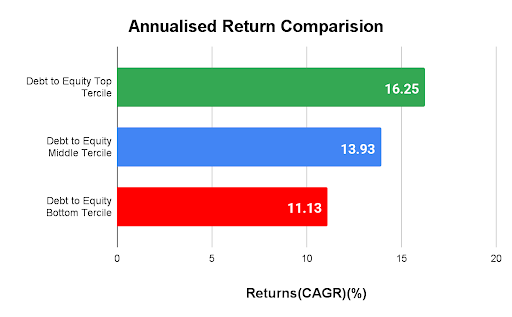
Source: Internal Research, CMIE, NJ AMC's Smartbeta Research Platform. Data is for the period 30th September 2006 to 31st December, 2025. Debt to Equity Top, Middle and Bottom Tercile Portfolio represents Top 33%, Middle 33% and Bottom 34% stocks respectively based on Debt to Equity parameter. Past performance may or may not be sustained in the future and is not an indication of future return. .NJ AMC's Smartbeta Research Platform is a proprietary module developed by NJAMC.
Overall, this matters for quality investing because the data show that companies with lower debt-to-equity ratios not only deliver higher long-term returns but also do so with lower volatility, smaller drawdowns, and more consistent rolling performance. That combination reflects stronger balance sheets and financial flexibility, helping businesses stay resilient in downturns, avoid refinancing stress, and maintain steady compounding across market cycles, which is exactly what quality-focused investing aims to capture.
What does a high ratio indicate?
A high debt-to-equity ratio generally indicates the company is more leveraged or that the portion of capital has a larger proportion of debt.
This can mean different things:
- It may reflect a planned strategy to fund expansion.
- It may reflect a capital-intensive business model.
- It may be fine if the cash flows are steadier, but it can become risky if the cash flows are not steady.
- High debt-to-equity often means higher risk, but it’s not necessarily bad. What’s important is whether the company can easily handle interest payments and repayments without affecting the long-term business strength.
What industries typically have high debt-to-equity ratios?
Some industries naturally operate with higher leverage because they require heavy investment in long-life assets and have predictable cash flows.
- Utilities and infrastructure-like businesses usually carry higher debt due to asset-heavy operations.
- Telecom can also be leverage-heavy due to ongoing network investment.
- Manufacturing and industrial businesses may carry moderate debt depending on capex and working capital cycles.
- Financials are a special case because leverage is part of the model, so D/E comparisons need extra care and often different metrics.
On the other hand, many asset-light sectors (like certain tech or services models) typically don’t need heavy borrowing to grow, so a high D/E there can stand out more.
What is the impact of debt on a company's equity?
Debt can influence equity in both direct and indirect ways.
- Indirectly through profits: Interest expense reduces profit, and lower profit means slower growth in retained earnings, which can slow equity growth.
- Through stress events: If debt becomes hard to service, the company may face losses, asset sales, or write-downs—all of which can reduce equity.
- Through capital decisions: Sometimes companies borrow and use funds for buybacks; buybacks reduce equity, which can push D/E higher even if the business is stable.
This is why balance sheet quality is not only about the level of debt but also about how debt interacts with profitability, cash flows, and capital allocation.
How to compare debt-to-equity ratios across companies?
The method is simple:
- Compare companies within the same sector and similar business model.
- Use the same definition of debt and equity for all comparisons.
- Compare the trend over time, not just one year.
- If one company looks like an outlier, check what changed: debt increase, equity decrease, or both.
This keeps the D/E comparison meaningful and fair.
Conclusion
Back to the uphill bicycle: a heavy suitcase doesn’t always mean the rider will fall, but it does mean the rider has less room for surprises. The D/E ratio helps you see who is climbing with a manageable load and who is relying too much on borrowed weight.
For quality investing, that clarity matters. Because the smoother the balance sheet, the easier it is to stay disciplined, stay invested, and allow compounding to do its work over time.
FAQs
Q) Is a low D/E ratio always better?
Not always. It can signal safety, but it can also mean the company isn’t using leverage even when it could do so prudently. Context matters.
Q) Can D/E change even if the company doesn’t take new debt?
Yes. Equity can change due to profits, losses, write-offs, or buybacks, which can move D/E.
Q) Should I compare D/E across different sectors?
It’s usually not a good idea. Compare within the same sector and similar business models.
Investors are requested to take advice from their financial/ tax advisor before making an investment decision.
MUTUAL FUND INVESTMENTS ARE SUBJECT TO MARKET RISKS, READ ALL SCHEME RELATED DOCUMENTS CAREFULLY.
« Previous Next »