
Factor Investing: Why Time Is the Hidden Ingredient of Wealth
Two friends: Arjun and Priya, started an SIP in the same factor fund on the same day.
Arjun checked his returns every week. After a few months of sluggish performance, he pulled out assuming the strategy had stopped working. Moved the money into whatever was trending that quarter.
Priya stayed invested. She continued her monthly SIP and understood that building long-term wealth requires patience. When markets or factors went through difficult phases, she didn't panic. Five years later, she called Arjun to share her returns. Same start date. Completely different outcomes, not because of the market, but because of patience.
That gap between Arjun and Priya wasn't a market gap. It was a behavioural gap, the difference between what a strategy earns and what an investor actually captures. This blog is about why that gap exists, what widens it, and how to make sure you're on the right side of it.
So, What Exactly Is Factor Investing?
A factor is simply: a characteristic or rule that consistently influences an outcome. Think of a factor as a filter, preference, or logic that helps you choose better options based on past evidence, not gut feel.
Suppose you want to buy a phone. You don't randomly pick one. You look at battery life, camera quality, price, and brand reliability. These are factors. You systematically filter choices based on characteristics you believe matter. These are decision factors. You believe phones with these features perform better for you
Factor investing is a systematic method of selecting stocks based on specific characteristics, called factors, that have historically been linked to better long-term returns. Instead of relying on gut feel, manager intuition, or market buzz, factor investing follows a predefined set of rules consistently over time.
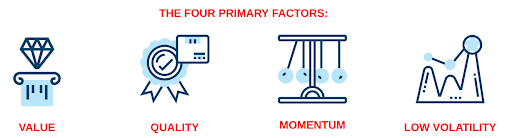
The most widely used factors include:
- Quality: Companies with strong financial health, low debt, and consistent earnings
- Value: Companies whose stock prices appear low relative to their actual business worth
- Momentum: Companies whose stocks have shown strong recent performance trends
- Low Volatility: Companies whose stock prices tend to be more stable than the broader market
The point of these factors isn't to predict tomorrow's market. The point is to systematically own the right characteristics, across multiple companies, over many years, so that the historical edge these factors carry has enough time and space to actually show up in your portfolio.
The Expectation Gap Nobody Warns You About
Here's how most investors discover factor investing.
Investors see a chart. Historical returns, cleanly plotted. Quality outperforming the index over 10 years. Value recovering dramatically after a prolonged slump. The numbers look compelling. The logic makes sense. So investors take the step and invest.
And then six months pass. There is no big movement in the returns.
Or worse, the fund slightly underperforms the index while a friend's fund becomes the highlight because it has better returns in that period.
This is what we call the expectation gap. Investors come in expecting the historical performance to show up almost immediately. When it doesn't, doubt creeps in fast.
The Part That Surprises Even Informed Investors: Factor Cyclicality
If there's one thing that trips up even well-read investors, it's this: every factor goes through extended periods of underperformance.
Not just weeks. Sometimes years. Think of it like a cricket team where different batsmen carry different innings. Sometimes the openers dominate. Sometimes the middle order saves the match. You wouldn't drop your best player after two quiet games, not if you understood what his career average actually looked like.
Factor leadership rotates. There are stretches where quality stocks lead the market. Other stretches where value stocks roar back after years of neglect. Phases where momentum works beautifully, followed by sharp reversals that punish the trend-chasers.
This is factor cyclicality. And it's not a bug. It's the nature of how markets work.
The investors who understand this going in are the ones who stay invested through the difficult phases. The ones who don't understand it, or forget it under pressure, are the ones who exit at exactly the wrong moment. Temporary underperformance is not evidence that a factor has broken. It's usually just the cycle doing what cycles do.
The Same Factors. Two Very Different Stories.
Table 1: The Difficult Phase
What if you had checked your returns at the worst possible moment?
March 2020. A global pandemic. Markets in freefall. If an investor had started a factor fund five years earlier and checked their returns that month, here is what they would have seen.
| INDEX (AS ON 31st MARCH 2020) | P2P 5Y CAGR |
| NIFTY 500 VALUE 50 TRI | -6.65% |
| NIFTY500 MOMENTUM 50 TRI | 4.68% |
| NIFTY500 LOW VOLATILITY 50 TRI | 5.36% |
| NIFTY500 QUALITY 50 TRI | 1.75% |
| NIFTY 500 TRI | 1.28% |
This is the number that makes investors doubt everything. Value was deeply negative. Quality had barely moved. This is exactly when most investors exit.
Table 2: The Recovery That Rewarded Patience
Now see what happened for investors who simply stayed.
Six years later, the same factors told a completely different story.
| INDEX (AS ON 31st MARCH 2026) | P2P 5Y CAGR |
| NIFTY 500 VALUE 50 TRI | 28.45% |
| NIFTY500 MOMENTUM 50 TRI | 16.46% |
| NIFTY500 LOW VOLATILITY 50 TRI | 14.91% |
| NIFTY500 QUALITY 50 TRI | 12.76% |
| NIFTY 500 TRI | 11.88% |
Every single factor beat the benchmark. The factor that looked most broken in 2020; Value at -6.65%, became the strongest performer by 2026 at 28.45%. The strategy didn't change. The investors who stayed benefited.
Table 3: The Fair Way to Judge a Factor Strategy
Point-to-point returns can be misleading depending on when you look. Rolling returns smooth out that timing risk and show the truer long-term picture.
| INDEX (AS ON 31st MARCH 2026) | 5Y Rolling Returns |
| NIFTY 500 VALUE 50 TRI | 14.28% |
| NIFTY500 MOMENTUM 50 TRI | 21.95% |
| NIFTY500 LOW VOLATILITY 50 TRI | 15.83% |
| NIFTY500 QUALITY 50 TRI | 16.77% |
| NIFTY 500 TRI | 13.62% |
Across all rolling return periods studied, every factor outperformed the benchmark. This is why long-term rolling returns are a more honest lens than a single snapshot in time, they remove the noise of when you happened to check.
Source: NJ AMC's Internal Research, CMIE, NSE, NJ AMC's Proprietary SmartBeta Research Platform. The start date for the data is 1st April 2005. Past performance may or may not be sustained and is not indicative of future returns.
The Biggest Mistake: Using Short-Term Emotions to Judge a Long-Term Strategy
Here's a scenario most investors recognise, even if they don't admit it.
You invest in a factor fund. For the first year, it's fine, nothing exciting, but nothing alarming. Then a difficult quarter hits. The fund drops more than the index. Your WhatsApp group is full of people talking about some new theme fund that returned 40% last year.
You start to wonder.
By the time you've gone through two or three cycles of this, hope, doubt, frustration, temptation, the urge to switch becomes very strong. And so you do. You exit the factor fund near a low, move into whatever looks good right now, and tell yourself you'll come back to factor investing "when it starts working again."
You've just done the exact opposite of what the strategy requires.
Why Time Isn't Just Helpful: It's the Ingredient
Factor investing is built on observations that took decades to identify. The relationships between quality companies and long-term returns, or between undervalued stocks and eventual price correction, don't play out in a quarter. They emerge over years; sometimes across a full market cycle.
Time does three things for a factor investor that no amount of research or portfolio monitoring can replicate.
Time helps investors ride through temporary setbacks, benefit from compounding, and look beyond short-term market noise.
Why Rules Matter More When Emotions Run High
This is where a rule-based framework earns its value; not in the good times, but in the uncomfortable ones.
A rule-based approach doesn't rely on the fund manager's mood, the market's sentiment, or your own conviction on a difficult day. It follows predefined criteria, consistently, systematically, regardless of what's happening around it.
This is the core philosophy behind NJ AMC's approach to factor investing. The portfolios are built on rules, not opinions. Rebalanced on schedule, not on emotion. Constructed transparently, so you always know what you own and why.
Rules help investors stay committed to a proven process when emotions are encouraging them to do the opposite.
A Practical Guide: What to Do and What to Avoid
| Do This | Don't Do This |
| Have a 5–7+ year investment horizon | Judge a long-term strategy on a few months of data |
| Understand factor cycles are normal | Switch strategies whenever another looks better |
| Evaluate the process, not recent performance | Let market noise override your investment thesis |
| Review performance at meaningful intervals | Expect all factors to outperform simultaneously |
| Stay disciplined during periods of discomfort | Mistake temporary underperformance for failure |
Conclusion:
The success of factor investing is not determined by what happens over the next quarter. It is determined by whether investors can stay committed through an entire market cycle.
History shows that factors can go through difficult phases. It also shows that investors who remain disciplined through those phases are the ones most likely to benefit when the cycle turns. That's why factor investing is built on rules, consistency, and patience rather than predictions and market timing.
The question isn't whether there will be periods of underperformance. There will be. The real question is whether you have a process that helps you stay invested when they arrive.
FAQs
Q) Why is factor investing considered a long-term strategy?
Factor investing seeks to capture factor premiums that have historically emerged over long periods. These premiums may not appear consistently in the short term and often require multiple market cycles to materialize.
Q) Can factor investing underperform for several years?
Yes. Individual factors can experience periods of underperformance depending on market conditions. This is a normal characteristic of factor cyclicality.
Q) What is the biggest risk in factor investing?
Often, the biggest risk is not the factor itself but investor behaviour. Abandoning a strategy during temporary underperformance can prevent investors from experiencing its long-term benefits.
SEBI Registered Name (Number): NJ Mutual Fund (MF/076/21/02) | Details of Other Regulatory Registrations: https://shorturl.at/SEBua
Investors are requested to take advice from their financial/ tax advisor before making an investment decision.
MUTUAL FUND INVESTMENTS ARE SUBJECT TO MARKET RISKS, READ ALL SCHEME RELATED DOCUMENTS CAREFULLY.
« Previous Next »