
Multifactor Investing: A Powerful Strategy for Long-Term Investors
Imagine a cricket selector trying to build a winning team with only aggressive openers. On a flat pitch, that team may look unstoppable. But on a turning track, in difficult weather, or in a tense run chase, that same line-up can suddenly look one-dimensional. A balanced team wins more often because different players step up in different conditions. Multifactor investing works in a very similar way.
In factor investing, one style may shine for a while, but market leadership is constantly shifting. That is why relying on just one factor can look impressive in the short term, but uncomfortable over a full market journey. A balanced line-up of factors can make the ride steadier and help investors stay committed through changing market cycles.
What Is Multifactor Investing?
Multifactor investing is an approach that combines multiple drivers of return, rather than relying on a single one. In simple terms, it brings together different styles of investing, such as the Quality Factor, Value Factor, Momentum Factor, and Low Volatility within one framework.
Each of these factors behaves differently. Quality focuses on businesses with strong financial characteristics. Value looks for companies that may be trading below their intrinsic worth. Momentum leans toward stocks that are already showing strength. Low Volatility aims to reduce the impact of sharper market swings. On their own, each factor has strengths, but each also has phases when it may struggle. A multifactor approach tries to blend these strengths so the portfolio is not tied to one market mood alone.
That is what makes multifactor investing appealing for long-term investing. It is less about finding the best factor for the next few months and more about building a framework that can remain useful across a wider range of market conditions.
How Factor Cycles Show Up in Markets
Markets do not move in a straight line. They pass through recovery, expansion, slowdown, and contraction. The challenge is that these shifts are easy to explain in hindsight, but very difficult to predict in real time.
This is where factor investing becomes interesting. Different factors tend to work better in different phases. Value may do well when pessimism starts fading and recoveries begin. Momentum may lead when trends are strong, and optimism is rising. Low Volatility may help more when markets become uncertain or defensive. Quality often provides resilience across phases, even if it is not always the loudest winner in every rally.
The key lesson is simple: no single factor consistently leads in every environment. Market cycles rotate, leadership rotates, and investor preferences rotate, too. When investors forget this, they often end up chasing what worked recently and abandoning it when the cycle turns. That is not a strategy. It is a short-term reaction.
Why Single-Factor Investing Can Feel Difficult
Single-factor investing can quietly become a market-timing exercise. A factor may look impressive when it is in favour, and disappointing when the leadership of that factor shifts. That performance swing can test patience.
For example, an investor may prefer Momentum after a strong market phase, only to feel uneasy when the market turns choppy. Another investor may admire the Value Factor after a recovery phase, but lose faith when growth-led names start dominating again. The issue is not that the factor is broken. The issue is that every factor has its season, and those seasons do not last forever.
This creates a behavioural challenge. Investors often buy into a factor after it has already had a strong run and then lose conviction during the cooling-off phase. In other words, they enter late and exit early. That is exactly how good ideas can deliver disappointing personal outcomes.
A multifactor approach helps address this problem. Instead of asking one factor to do every job, it allows different factors to play different roles. Much like a balanced sports team, the goal is not to have eleven stars doing the same thing. The goal is to have a line-up that can adapt when conditions change.
Why Multifactor Investing Delivers More Consistent Outcomes
The real strength of multifactor investing is not that it will always be the top performer. Its strength is that it aims to avoid being too dependent on one market phase.
When one factor falls out of favour, another may offer support. That can make performance more even across time. It may not produce fireworks that is perform in every phase, but it can reduce the sharp disappointment that often comes with single-style investing. That matters because avoiding deep disappointment is often more useful than chasing short-term hype.
Consistency matters because investor behaviour matters. Many portfolios do not work not because the strategy had no merit, but because the investor could not stay with it. A steadier journey improves the chances of staying invested, and staying invested is often where long-term compounding does its real work.
This is also why diversification within factor investing is so powerful. It is not diversification for the sake of appearances. It is diversification designed around the simple reality that markets change and no single lens is enough all the time.
| RECOVERY | EXPANSION | SLOWDOWN | CONTRACTION |
| NIFTY 500 VALUE 50 TRI (46.81%) | NIFTY500 MOMENTUM 50 TRI (25.95%) | NIFTY500 LOW VOLATILITY 50 TRI (2.35%) | NIFTY500 LOW VOLATILITY 50 TRI (-10.58%) |
| NIFTY500 QUALITY 50 TRI (34.72%) | NIFTY 500 VALUE 50 TRI (24.24%) | NIFTY500 MULTIFACTOR MQVLV 50 TRI (0.81%) | NIFTY500 MULTIFACTOR MQVLV 50 TRI (-12.01%) |
| NIFTY500 MULTIFACTOR MQVLV 50 TRI (32.34%) | NIFTY500 MULTIFACTOR MQVLV 50 TRI (19.8%) | NIFTY500 QUALITY 50 TRI (0.39%) | NIFTY500 QUALITY 50 TRI (-13.05%) |
| NIFTY500 LOW VOLATILITY 50 TRI (27.17%) | NIFTY500 QUALITY 50 TRI (17.32%) | NIFTY500 MOMENTUM 50 TRI (0.07%) | NIFTY500 MOMENTUM 50 TRI (-16.73%) |
| NIFTY500 MOMENTUM 50 TRI (23.59%) | NIFTY500 LOW VOLATILITY 50 TRI (16.03%) | NIFTY 500 VALUE 50 TRI (-6.84%) | NIFTY 500 VALUE 50 TRI (-16.92%) |
Source: NJ AMC Internal Research, CMIE, NSE, NJ AMC SmartBeta Research Platform. Factors refer to Nifty 500 (Value 50 TRI, Momentum 50 TRI, Low Volatility 50 TRI, Quality 50 TRI, Multifactor MQVLV 50 TRI). Half-yearly periods (Apr 2005–Dec 2025) are classified into four market phases; the shown returns are the average absolute half-yearly returns within each phase. Past performance may or may not be sustained and is not indicative of future returns.
Why Risk-Adjusted Efficiency Matters
Returns alone never tell the full story. Two strategies may generate similar results over time, but the journey can feel very different. One may come with sharper swings, deeper drawdowns, and more emotional stress. The other may offer a smoother path.
That is why risk-adjusted efficiency matters. Low Volatility may offer stability, but not always the strongest upside. Momentum may generate stronger gains in the right phase, but with higher swings. Quality may provide durability, but not always immediate excitement. A multifactor approach seeks a middle path by combining these different characteristics.
This idea is important for everyday investors. Investing is not only about how much a strategy earns. It is also about how comfortably an investor can live with the process of earning it. A strategy that balances return potential with manageable risk often stands a better chance of helping investors remain calm and committed through different phases of the market.
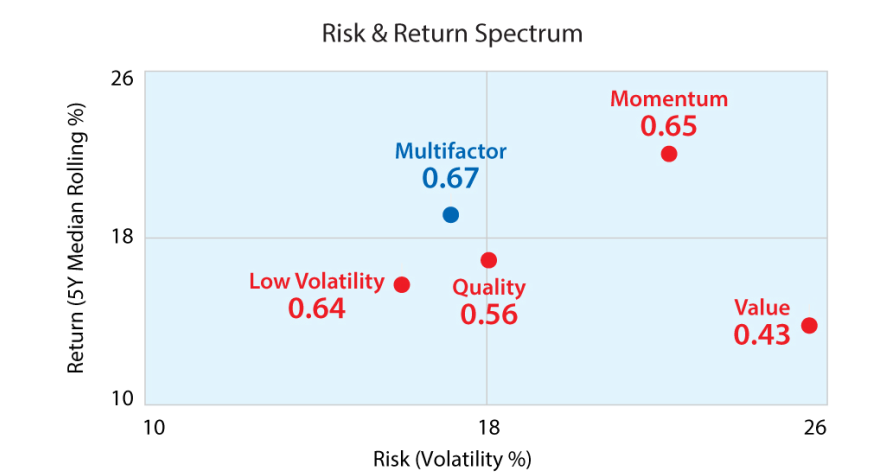
Source: NJ AMC's Internal Research, CMIE, NSE, NJ AMC's Proprietary SmartBeta Research Platform. Factors refer to Nifty 500 (Value 50 TRI, Momentum 50 TRI, Low Volatility 50 TRI, Quality 50 TRI, Multifactor MQVLV 50 TRI). Data is for the period 1st April, 2005 to 31st December, 2025.
| Index | 5Y Median Rolling (%) | Volatility (%) | Sharpe Ratio |
| NIFTY 500 VALUE 50 TOTAL RETURN INDEX | 13.81 | 25.58 | 0.43 |
| NIFTY500 MOMENTUM 50 INDEX - TOTAL RETURN INDEX | 22.06 | 22.29 | 0.65 |
| NIFTY500 LOW VOLATILITY 50 - TOTAL RETURN INDEX | 15.77 | 16.02 | 0.64 |
| NIFTY500 QUALITY 50 - TOTAL RETURN INDEX | 16.95 | 18.06 | 0.56 |
| NIFTY500 MULTIFACTOR MQVLV 50 - TOTAL RETURN INDEX | 19.13 | 17.17 | 0.67 |
Source: NJ AMC's Internal Research, CMIE, NSE, NJ AMC's Proprietary SmartBeta Research Platform. Data is for the period 1st April, 2005 to 31st December, 2025.
How To Approach Multifactor Investing With Discipline
Multifactor investing works best when it is treated as a disciplined process, not as a trend. First, investors need to accept that market cycles cannot be forecast with confidence every time. Trying to guess the next winning factor can become a tiring and often costly exercise.
Second, the framework should remain rule-based. A rule-based investing approach reduces the urge to chase headlines, recent winners, or short-term noise. It keeps the portfolio anchored to a process rather than emotion.
Third, investors should think in terms of long-term investing. Multifactor strategies are built to work across phases, not over a few dramatic weeks. That means patience is not optional; it is part of the strategy itself.
At NJ AMC, multifactor investing is approached as a disciplined, rule-based framework rather than a response to recent performance. By focusing on the Quality factor and meaningfully combining it with other factors such as Value, Low Volatility, and Momentum, the strategy seeks to deliver smoother outcomes across market cycles.
Finally, remember the real objective: not to win every short sprint, but to improve the odds of finishing the full journey well. A portfolio built with balance, diversification, and discipline can often do more for investors than one built around the latest market favourite.
Conclusion
Go back to that cricket team for a moment. A side filled with only attacking batters may look thrilling on paper, but championships are usually won by teams with balance. They have solidity, flexibility, defence, attack, and the temperament to handle different situations. Multifactor investing follows the same principle. It combines different strengths, so the portfolio does not depend too heavily on one market environment, one factor, or one trend.
That is the real power of a balanced line-up. In a world where market cycles keep shifting and leadership keeps rotating, multifactor investing offers a more grounded way to participate. It may not always be the loudest strategy in the room, but it can be one of the more dependable ones. And just like a well-balanced cricket team stays in the game across changing conditions, a thoughtfully built multifactor approach can help investors stay steady, stay invested, and learn that long-term success often comes from balance rather than bursts of brilliance.
FAQs
Q) Does multifactor investing always outperform every single factor?
No. A multifactor strategy may not lead in every phase. Its value lies more in consistency, diversification, and a better balance between return potential and risk.
Q) How does multifactor investing help during market volatility?
By combining factors with different strengths, it can reduce the impact of one factor underperforming. For example, Low Volatility may offer support when markets are stressed, while Momentum or Value may help in other phases.
Q) Who can consider multifactor investing?
It can suit investors who believe in long-term investing and want a disciplined, diversified framework instead of trying to predict which single factor will win next.
Investors are requested to take advice from their financial/ tax advisor before making an investment decision.
MUTUAL FUND INVESTMENTS ARE SUBJECT TO MARKET RISKS, READ ALL SCHEME RELATED DOCUMENTS CAREFULLY.
« Previous Next »