
The Ultimate Guide to Finding the Right Factor For You
Introduction
Imagine you are at a restaurant with four excellent chefs. Each specialises in something different. One makes a blend of flavours and spicy dishes. Another prepares slow-cooked, with complex international cuisine flavours. The third chef cooks simple, wholesome food. And the fourth chef prepares different salads.
Now imagine picking a chef not because you like their food, but because someone at the next table said theirs looked great. You order it, take three bites, and realise it does not suit your palate at all. You leave the table half-finished.
That is exactly what happens when investors chase factor performance without asking whether a particular factor actually suits them. Every factor works. But not every factor works for every person. The difference between a great investment experience and a frustrating one often comes down to fit, not performance.
Quick Check: Which Investor Are You?
Pick the investor who sounds closest to you.
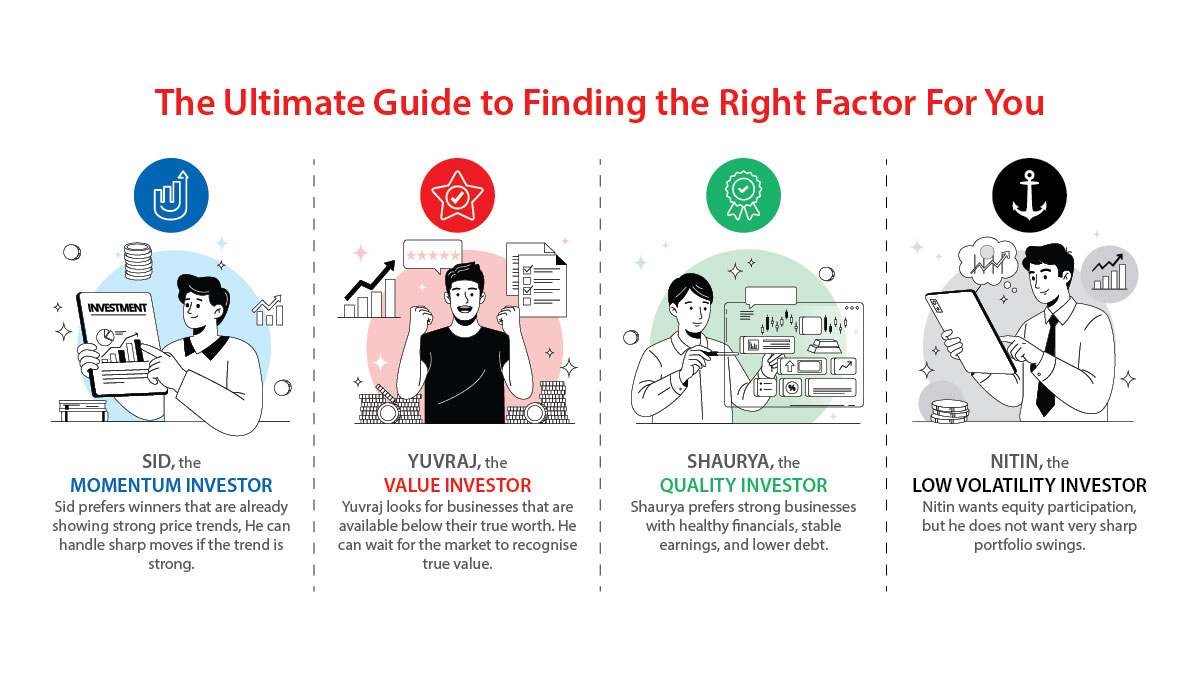
Sid, the Momentum Investor
Sid prefers winners that are already showing strong price trends, He can handle sharp moves if the trend is strong.
Yuvraj, the Value Investor
Yuvraj looks for businesses that are available below their true worth. He can wait for the market to recognise true value.
Shaurya, the Quality Investor
Shaurya prefers strong businesses with healthy financials, stable earnings, and lower debt.
Nitin, the Low Volatility Investor
Nitin wants equity participation, but he does not want very sharp portfolio swings.
Keep your answer in mind as you read.
Why Choosing the Right Factor Matters More Than Chasing Returns
Many investors pick factors by looking at what worked recently. If Momentum has done well, they want Momentum. If Value has recovered and performed well, they want Value. If Low Volatility looks stable, they become interested in Low Volatility. This is where the problem begins.
Factors move in cycles. One factor may lead in one period and lag in another. The same factor that looks strong today may go through a dull phase later at some point. That is why choosing a factor only by looking at recent returns can lead to poor investor behaviour.
A factor can be strong, but the investor may still exit at the wrong time if the journey does not suit them. That is why the real question is simple:
Which factor can you stay invested in when it underperforms?
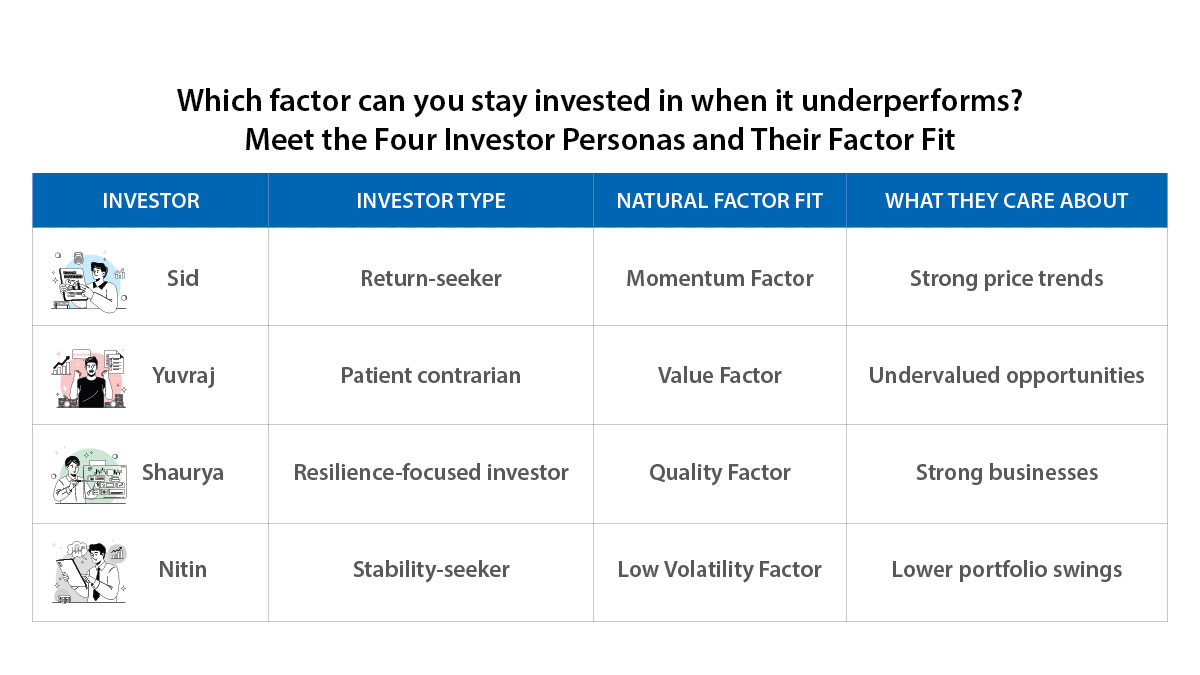
For Illustration purposes only
Sid, the Momentum Investor
Sid likes strength.
When he looks at the market, he wants to know which stocks are leading, which sectors are gaining traction, and where price action is strong. He doesn't like sitting too long in stocks that are not moving.
For Sid, Momentum Factor Investing is a natural fit.
Momentum focuses on stocks that have shown strong recent price performance. The idea is that stocks already moving strongly may continue to do well for some time.
But Sid has to accept one thing. Momentum can change direction quickly. A stock or sector that is leading today may lose steam when market leadership rotates.
Sid’s Investing Style
Sid may suit Momentum if he:
- Has a higher risk appetite
- Can handle sharp portfolio movements
- Is comfortable with market trends
- Understands that leadership can rotate quickly
- Does not panic during short-term corrections
Sid’s Factor Reminder
Momentum can reward discipline, but it can also test nerves.
Sid should not enter Momentum only because it has recently performed well. He should enter only if he can handle the speed and the sudden reversals that come with it.

Yuvraj, the Value Investor
Yuvraj looks where others are not looking.
He is not easily impressed by popular stocks or market excitement. If a stock looks ignored but has underlying worth, he becomes interested. He believes that markets can overreact and that mispricing can create opportunities.
For Yuvraj, the Value Factor is a natural fit.
Value investing focuses on stocks that appear undervalued compared to their fundamentals or intrinsic worth. These stocks may be out of favour today, but the investor expects the market to recognise their value over time.
The challenge is patience.
Value can look weak for long periods. It can test the investor because the market may take time to change its view.
Yuvraj’s Investing Style
Yuvraj may suit Value if he:
- Is genuinely patient
- Can handle being early
- Does not need quick validation
- Is comfortable going against the crowd
- Can wait for fundamentals to be recognised
Yuvraj’s Factor Reminder
Value needs time, patience, and conviction.
Yuvraj should not choose Value if he expects instant results. Value works best for investors who can stay calm when the market is ignoring their chosen factor.

Shaurya, the Quality Investor
Shaurya focuses on the strength of the business.
He looks for companies with strong return ratios, stable earnings, healthy cash flows, and lower debt. He does not want to chase every fast-moving market idea. He prefers businesses that can hold their ground across market cycles.
For Shaurya, Quality Factor Investing is a natural fit.
Quality focuses on companies with strong financial fundamentals. These businesses may be better placed to handle difficult market conditions and recover steadily after stress.
But Quality also has a trade-off. In a very aggressive bull market, where risky stocks are rising fast, Quality may look slow.
Shaurya is okay with that. He is not investing for excitement. He is investing for resilience.
Shaurya’s Investing Style
Shaurya may suit Quality if he:
- Prefers strong businesses
- Values financial discipline
- Wants resilience during market stress
- Thinks long term
- Does not want to chase every market rally
Shaurya’s Factor Reminder
Quality may not always be the fastest, but it focuses on strength.
Shaurya should not compare Quality with high-risk strategies during every market rally. Quality is built for investors who prefer durability over constant excitement.

Nitin, the Low Volatility Investor
Nitin wants equity exposure, but sharp falls make him uncomfortable.
He understands the importance of long-term investing, but he does not want a portfolio journey that keeps him worried. If his portfolio falls too much, he may feel tempted to exit.
For Nitin, the Low Volatility Factor is a natural fit.
Low Volatility focuses on stocks that have historically shown lower price fluctuations. It does not remove risk. Equity investing will always carry risk. But it can help make the ride smoother for investors who are sensitive to drawdowns.
Nitin is not trying to be the top performer in every market phase. His priority is staying invested without panic.
Nitin’s Investing Style
Nitin may suit Low Volatility if he:
- Dislikes sharp drawdowns
- Wants a smoother equity journey
- Values capital preservation
- May panic during steep market falls
- Prefers steady participation over aggressive returns
Nitin’s Factor Reminder
Low Volatility can make equity participation feel more manageable.
Nitin should not expect Low Volatility to beat aggressive strategies in every rising market. Its role is to reduce the discomfort of sharp swings.

Same Factor, Different Time, Very Different Outcome
Before choosing a factor, investors should understand one simple point: factor returns can look very different depending on when you look at them.
| INDEX (AS ON 31st MARCH 2020) | P2P 5Y CAGR |
|---|---|
| NIFTY 500 VALUE 50 TRI | -6.65% |
| NIFTY500 MOMENTUM 50 TRI | 4.68% |
| NIFTY500 LOW VOLATILITY 50 TRI | 5.36% |
| NIFTY500 QUALITY 50 TRI | 1.75% |
| NIFTY 500 TRI | 1.28% |
| INDEX (AS ON 31st MARCH 2026) | P2P 5Y CAGR |
|---|---|
| NIFTY 500 VALUE 50 TRI | 28.45% |
| NIFTY500 MOMENTUM 50 TRI | 16.46% |
| NIFTY500 LOW VOLATILITY 50 TRI | 14.91% |
| NIFTY500 QUALITY 50 TRI | 12.76% |
| NIFTY 500 TRI | 11.88% |
| INDEX (AS ON 31st MARCH 2026) | 5Y CAGR |
|---|---|
| NIFTY 500 VALUE 50 TRI | 14.28% |
| NIFTY500 MOMENTUM 50 TRI | 21.95% |
| NIFTY500 LOW VOLATILITY 50 TRI | 15.83% |
| NIFTY500 QUALITY 50 TRI | 16.77% |
| NIFTY 500 TRI | 13.62% |
Source: NJ AMC's Internal Research, CMIE, NSE, NJ AMC's Proprietary SmartBeta Research Platform. The start date for the data is 1st April 2005. Past performance may or may not be sustained and is not indicative of future returns.
Look at the value factor. As on 31st March 2026, NIFTY 500 Value 50 TRI delivered a 5-year point-to-point CAGR of 28.45%. As on 31st March 2020, the same index had delivered -6.65% over five years. The factor did not change. The time period changed.
This is what factor cycles look like in practice. A factor that appears to be a winner today may have looked deeply disappointing just a few years ago, and vice versa. Choosing a factor based only on recent returns means you are always looking in the rear-view mirror.
This is exactly why exiting a factor too early can be costly. An investor who lost patience with Value in 2020 may have missed the strong recovery that followed. The return was waiting, but the investor needed to stay invested long enough to experience it.
Every factor has rewarded investors over the long run. None has done so in a straight line. That is why the real risk is not only choosing the wrong factor. It is exiting the right factor too early.
Single Factor vs Multifactor: What Suits Your Investing Style?
A single factor approach can work well when the investor has strong conviction. Sid may choose Momentum with full understanding of its sharp reversals. Yuvraj may choose Value knowing that patience is required. Shaurya may choose Quality because he values strong businesses. Nitin may choose Low Volatility because he wants a smoother equity experience.
But many investors are not purely one type. You may like Momentum, but also want some Quality. You may believe in Value, but also want lower volatility. You may want equity growth, but not the pressure of guessing which factor will lead next.
That is where Multi Factor Investing can help. A multifactor strategy combines factors such as Momentum, Value, Quality, and Low Volatility. It reduces dependence on one factor cycle. When one factor is going through a weak phase, another factor may help balance the journey.
Choose Single Factor if:
You clearly understand one factor, accept its weak periods, and can stay invested with conviction.
Choose Multi Factor if:
You want a more balanced factor journey and do not want to depend on one factor working at the right time.
Mini Quiz: Find Your Factor
Choose one answer for each question.
Question 1: What do you usually notice first in the market?
A. Stocks or sectors with strong price trends
B. Stocks that look undervalued
C. Companies with strong fundamentals
D. Stocks with lower price swings
Question 2: What makes you most uncomfortable?
A. Missing a strong market trend
B. Buying a stock at an expensive valuation
C. Owning weak businesses
D. Seeing sharp portfolio falls
Question 3: Your factor underperforms for 18 months. What do you do?
A. Stay if the trend process still makes sense
B. Wait because value can take time
C. Review business quality and stay disciplined
D. Look for a smoother strategy
Question 4: What kind of equity journey do you prefer?
A. Fast-moving and trend-led
B. Patient and valuation-led
C. Steady and fundamentals-led
D. Conservative and lower-swing
Your Result
Mostly A: You may be like Sid, the Momentum Investor.
Mostly B: You may be like Yuvraj, the Value Investor.
Mostly C: You may be like Shaurya, the Quality Investor.
Mostly D: You may be like Nitin, the Low Volatility Investor.
Mixed answers: You may be better suited to a Multifactor approach.
A Simple Step-by-Step Framework to Find Your Factor Fit
Not sure which category you fall into after the quiz?
Use this two-step filter.
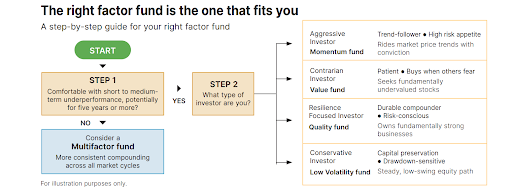
- First, ask yourself whether you can genuinely stay invested through five or more years of underperformance without switching.
- If the answer is no, a Multifactor approach may suit you better than any single factor.
- If yes, move to the second question, which investor type resonates most with your natural instincts?
Your answer points directly to your factor fit.
Conclusion
Let's return to Sid, Yuvraj, Shaurya, and Nitin checking their portfolios. Each of them is looking at a different number on the screen. Each of them feels something different about what they see. And each of them needs a different reason to stay invested.
Sid stays because the trend still makes sense to him. Yuvraj stays because he knows patience is the edge. Shaurya stays because the businesses he owns are still strong. Nitin stays because the journey has been smoother than he feared.
None of them is wrong. They simply needed different factor strategies, ones that matched not just their financial goals, but their temperament.
There is no universally best factor. Every factor goes through periods of outperformance and disappointment. The right factor is not the one with the highest recent returns. It is the one you can understand clearly, tolerate honestly, and stay invested in through full market cycles, because the return was always waiting. The question was only whether you stayed long enough to receive it.
For investors who are unsure about depending on a single factor cycle, a diversified multifactor strategy may offer a more balanced and consistent compounding journey across market conditions.
FAQs
Q) I keep switching between factors based on what performed well recently. What should I do?
This is one of the most common mistakes in factor investing. Factors move in cycles, and recent performance is often the worst guide to future returns. The better question to ask is: which factor can I stay invested in when it underperforms for one to three years? Start there, and your factor choice will follow naturally.
Q) Should I choose a factor based on recent returns?
No. Recent returns can be misleading because factors move in cycles. A factor that performed well recently may underperform later, and a factor that is currently weak may recover over time.
Q) Can conservative investors participate in factor investing?
Yes. Conservative investors typically find Low Volatility factor more aligned with their temperament, as these focus on stocks with historically lower price swings. Alternatively, a Multifactor approach spreads exposure across multiple factors, which can reduce dependence on any single factor's cycle and provide a smoother long-term journey. The key is choosing a factor whose journey you can stay committed to, not just one whose past returns look attractive.
Q) What if I relate to more than one investor type?
Many investors do. If you see yourself in two or more of the personas described above, for example, you value Quality businesses but also want lower portfolio swings; that is a strong signal that a Multifactor approach may suit you better than a single factor strategy. Multifactor investing is specifically designed for investors who want the benefits of multiple factors without having to predict which one will lead next.
SEBI Registered Name (Number): NJ Mutual Fund (MF/076/21/02) | Details of Other Regulatory Registrations: https://shorturl.at/SEBua
Investors are requested to take advice from their financial/ tax advisor before making an investment decision.
MUTUAL FUND INVESTMENTS ARE SUBJECT TO MARKET RISKS, READ ALL SCHEME RELATED DOCUMENTS CAREFULLY.
« Previous Next »