
Rule-Based Portfolio Construction: How It Works In An AMC
Have you ever wondered how rule-based investing actually works inside an AMC, and how rule-based portfolios are constructed not on opinions, market noise, or today’s best idea, but on a clear set of rules?
In a rule-based investing approach, every important decision is defined upfront: which stocks are eligible to be considered, which ones get rejected, which ones get selected, how much to allocate, and when to rebalance. That’s why rule-based investing is often seen as a process-led way of investing, which is built to stay steady even when markets (and emotions) swing.
In this blog, we simplify what rule-based investing means, what systematic strategies are, how they differ from discretionary investing, and how rule-based AMCs construct portfolios. We’ll also cover how NJ AMC constructs portfolios using rules, and how key pitfalls in the portfolio construction are avoided.
What is Rule-Based Investing?
Rule-based investing is an investment approach where decisions are made using a pre-defined, objective set of rules so the portfolio is constructed and managed based on eligibility criteria, filters, rankings, limits, and rebalancing rules, rather than personal opinions, predictions, or day-to-day market noise.
Rule-based (systematic) strategies are investment strategies where the AMC converts an investing idea into a repeatable, step-by-step method that can be run the same way every time.
In mutual fund portfolio construction, a systematic strategy typically defines:
- The universe: which stocks are eligible to be considered
- The filters: which stocks must be excluded (risk, governance, liquidity, etc.)
- The selection logic: how stocks are chosen (ranking/scoring using factors like quality, value, momentum, low volatility—based on the strategy)
- Portfolio rules: how many stocks to hold, stock/sector caps, and other limits
- Rebalancing rules: when the portfolio will be refreshed and how changes are implemented
- Monitoring rules: what gets tracked to ensure the portfolio stays aligned to the framework
Difference Between Rule-Based Investing and Traditional Discretionary Investing:
| Sr No. | Difference point | Rule-based investing | Traditional Discretionary investing |
|---|---|---|---|
| 1 | Decision driver | Follows a pre-defined framework | Follows the fund manager’s judgement |
| 2 | How stocks are selected | Uses filters along with scoring/ranking rules | Uses research along with conviction and interpretation |
| 3 | How the approach is evaluated | Backtesting of rules across long periods | Fund/manager track record across long periods |
| 4 | Who builds the approach | Research teams design models and rules | Fund managers and research analysts make decisions through research |
| 5 | How portfolio changes happen | Changes follow defined review/rebalance rules | Changes follow active decisions as views evolve |
Understanding How a Rule-Based Portfolio is Constructed:
| Sr No. | Steps | Description |
| 1 | Universe Selection | Choose a group of stocks to pick from. Like Large Cap, Mid Cap, or Small Cap, or Nifty 500, etc |
| 2 | Portfolio Size | Decide how many stocks to include in your portfolio. |
| 3 | Elimination and Selection Factors | Use rules to remove stocks that don’t fit your needs. For example: • PE Ratio: Remove overvalued stocks • Debt: Remove companies with too much debt • Growth: Choose companies with good, steady growth • Dividends: Pick companies with reliable dividend payouts |
| 4 | Weighting | Decide how much of each stock to buy. You can base this on: • Company size: Bigger companies may get more weight • Risk: Riskier stocks get less weight to reduce the chance of big losses • Sector: Don’t put all your money into one industry; spread it out |
| 5 | Rebalancing | Periodically check and adjust your portfolio to keep it on track. For example: • Thresholds: Rebalance if any stock goes over or under your desired weight by a certain percentage (e.g., 5%) • Changes: If a stock no longer fits your goals, replace it with one that does |
| 6 | Asset Allocation | Decide how much of your money to allocate to stocks, bonds, or other investments. Rules can help: • Stock-to-Bond ratio: For example, invest 60% in stocks and 40% in bonds based on risk preferences • Risk Levels: Riskier investors can have more in stocks, while conservative ones focus on bonds |
| 7 | Risk Management | Set rules to manage how much risk you are willing to take: • Stop-loss: Set limits to sell stocks if they drop below a certain price • Diversification: Spread investments across different sectors and regions to reduce risk |
| 8 | Rebalancing | Similar to the earlier rebalancing step, but focused on adjusting your portfolio to stay aligned with your goals, especially after big market changes. For example, if your stocks rise and dominate your portfolio, you may need to sell some to rebalance. |
| 9 | Investment Timing | Set rules for when to buy and sell. You can use: • Market indicators: For example, buy when stock prices are low and sell when they’re high • Economic news: If the economy is doing well, it may be a good time to invest, or you may wait for a dip in the market |
NJ AMC Philosophy:
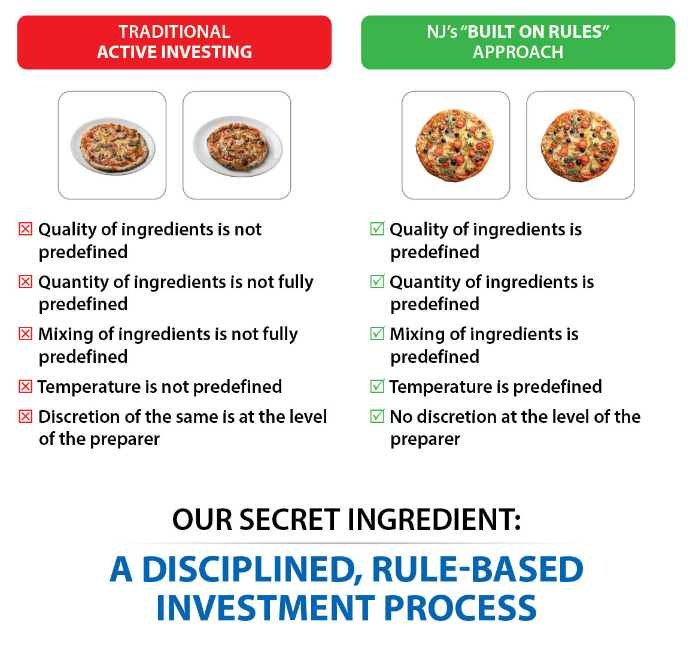
Just like making a great pizza isn’t just about having a talented chef, it’s about having a reliable and tested recipe. When the ingredients are chosen carefully, the portions are measured, the mixing method is set, and the oven temperature is controlled, you get the same great taste every time, even if the chef changes the quality, the texture & taste remain completely unchanged
That’s the idea behind NJ’s Built on Rules approach. At NJ AMC, we believe in rules over noise and process over prediction. Our portfolios are built using a disciplined, repeatable, rule-based framework that is focused on quality, transparency, and being true-to-label across market cycles. Above all, we stay customer-centric, designing with risk-awareness so investors can invest with confidence.
How NJ AMC Constructs Rule-Based Portfolio?
| Sr No. | Steps | Description |
| 1 | Universe Selection | The universe will be all companies in the Nifty 500 Index. |
| 2 | Elimination and Selection Factors | 1) Elimination of illiquid stocks. |
| 2) Elimination based on governance and forensic filters | ||
| 3) Eliminate highly volatile and anti-quality companies | ||
| 4) Shortlist high-quality companies using quality parameters (separate parameters for lending vs non-lending) | ||
| 5) Use a proprietary business-specific value scoring framework to select undervalued, high-quality companies (Applied for 80-100 High Quality Stocks) | ||
| 3 | Final Portfolio | All shortlisted stocks are further screened for various forensic and governance aspects. |
| 4 | Quality Parameters (Non-Lending Companies) | High and consistent ROE; High and consistent Dividend Payout; Debt-to-Equity. |
| 5 | Quality Parameters (Lending Companies) | Net Interest Margin (NIM); Net Interest Income (NII); Return on Assets (ROA). |
| 6 | Weighting | Weighting based on the Smart Factor Shift Model |
| 7 | Risk Management | Top 2 sectors exposure capped at 25% and 20% at each rebalance date (respectively). Also uses Smart FactorShift model for dynamically shifting factor exposure based on market environment. |
| Smart FactorShift Model: Risk-on: higher exposure to Momentum (aggressive); Risk-off: Higher exposure to Low Volatility (defensive); Extreme high/low valuation environment: Higher exposure to Value / Low Volatility. | ||
| Stock cap (5%) and sector caps (25% / 20%) are applied at each rebalance date. |
Common Pitfalls in Rule-Based Portfolios:
- Poor input quality: Incorrect data drives wrong decision-making.
- Survivorship bias in testing: Survivorship bias happens when you judge a portfolio/strategy using only the stocks that are still alive today, and ignore the ones that disappeared
- Corporate actions: When corporate actions aren’t adjusted, the price chart and return calculations lie, because the stock’s price changes for a mechanical reason (split/bonus/dividend), not because the business suddenly gained or lost value.
- Value traps: Cheap stocks that are fundamentally weak.
- Momentum traps: Buying recent winner stocks near peaks without risk controls.
- Concentration risk: Few stocks/sectors dominate the portfolio.
- Liquidity risk: Portfolio includes stocks that are hard to trade or that have low liquidity.
- Regime blindness: The same factor tilt is used in both risk-on and risk-off markets.
- Rule drift: Portfolio gradually deviates because rules aren’t re-applied consistently.
How NJ AMC Avoids These Common Pitfalls:
- Data Quality: Does hygiene checks and data accuracy checks to ensure that the data is correct and relevant.
- Input quality: Uses governance and forensic filters, and then re-screens shortlisted stocks again for governance/forensic aspects before final selection.
- Survivorship bias in testing: Uses the Nifty 500 universe as the reference set; for fair evaluation, the process should be tested on point-in-time Nifty 500 constituents.
- Corporate actions: Uses corporate-action-adjusted price/return data so splits/bonuses/dividends don’t distort momentum, volatility, or return calculations.
- Value traps: Applies quality filters first (removing anti-quality stocks), then selects only undervalued, high-quality companies using the business-specific value scoring framework.
- Momentum traps: Uses Smart FactorShift to avoid being blindly aggressive—tilts to Momentum in risk-on, shifts to Low Volatility in risk-off, and leans to Value/Low Volatility in extreme valuation conditions.
- Concentration risk: Enforces caps at every rebalance, which is a maximum 5% per stock, and the top 2 sectors are capped at 25% and 20% (respectively).
- Liquidity risk: Runs a liquidity profile screen at the end—shortlisted stocks are further checked for forensic, governance, and liquidity before inclusion.
- Regime blindness: Adjusts factor exposure based on market regime via Smart FactorShift (risk-on / risk-off / extreme valuation).
- Rule drift: Re-applies the full ruleset at each rebalance date with filters, scoring, caps, and factor shifts, so the portfolio stays aligned with the methodology.
Conclusion:
Rule-based investing is built on a simple idea: you don’t need to predict the next market move to build a sensible portfolio. All that investors need is a repeatable process they can trust. When every decision is defined upfront, which includes universe, filters, selection logic, weighting rules, risk limits, and rebalancing, portfolio construction becomes more consistent, transparent, and less dependent on emotions or market noise.
That’s also what NJ AMC’s “Built on Rules” philosophy stands for. By starting with a defined universe, filtering out governance and forensic risks, avoiding anti-quality and high-volatility names, selecting using business-specific quality and value frameworks, and adding discipline through caps, liquidity checks, and Smart FactorShift, the approach aims to stay true-to-label across market cycles.
Markets will always be unpredictable. But the way a portfolio is built doesn’t have to be. In the end, rule-based investing is a reminder that long-term outcomes are often shaped not by perfect forecasts but by process over prediction, and discipline over noise.
FAQs
Q) What is rule-based investing in simple terms?
Rule-based investing means portfolios are built and managed using pre-defined rules (eligibility, filters, selection, weighting, and rebalancing) instead of opinions or day-to-day market calls.
Q) Is rule-based investing the same as passive investing?
Not necessarily. Passive funds track an index. Rule-based (systematic) funds use rules to select and weight stocks and may look very different from an index, even if they start from a broad universe like the Nifty 500.
Q) How does a rule-based portfolio decide which stocks are eligible?
It begins with a defined universe (e.g., Nifty 500), then applies eligibility screens like liquidity thresholds, governance exclusions, and risk constraints.
Investors are requested to take advice from their financial/ tax advisor before making an investment decision.
MUTUAL FUND INVESTMENTS ARE SUBJECT TO MARKET RISKS, READ ALL SCHEME RELATED DOCUMENTS CAREFULLY.
« Previous Next »