
Quality Investing Simplified: What is Current Ratio and its Importance?
Picture a household that earns well and looks affluent from the outside. Nice furniture, a car in the garage, fancy decor. But when the rent is due at the end of the month, they find themselves scrambling with a thin savings account, money tied up in fixed deposits that can't be touched for a year, and stretched credit card dues. Impressive assets, real income, but a short-term cash crunch.
This is not a rare situation in business, either. Companies can look profitable on paper, report growing revenues, and still face trouble paying what's due in the near term. Suppliers waiting to be paid, loan instalments coming due, and salaries to be cleared. The ability of a business to handle these near-term obligations from near-term resources is what liquidity is about. And the Current Ratio in investing is one of the simplest, most practical tools to check just that.
For investors focused on quality investing, this matters a great deal. A company that can't manage its short-term finances, no matter how strong its long-term story, carries hidden fragility.
What is the Current Ratio?
The Current Ratio measures a company's ability to meet its short-term obligations (due within one year) using its short-term assets (also convertible within one year). In simple terms: for every ₹1 the company owes in the near term, how many rupees does it have available in near-term resources?
Formula: Current Ratio = Current Assets / Current Liabilities
Current Assets include resources that can be converted into cash within a year:
- Cash and cash equivalents
- Short-term investments
- Trade receivables (money owed by customers)
- Inventories (raw materials, work-in-progress, finished goods)
- Prepaid expenses and other short-term assets
Current Liabilities include obligations due within a year:
- Trade payables (money owed to suppliers)
- Short-term borrowings
- Accrued expenses
- Advance payments received from customers
- Current portion of long-term debt
Understanding the Current Ratio
1) Higher is generally better, but not always: A current ratio above 1.0 means the company has more short-term resources than near-term obligations. That's a baseline comfort. A ratio above 1.5 to 2.5 is often considered healthy for most non-financial businesses.
However, a very high current ratio (say, above 2 or 3) is not always good. It can sometimes indicate that the company is holding excess idle cash, letting receivables pile up, or sitting on a large, slow-moving inventory. In such cases, a high ratio might actually signal poor working capital management, not strength.
2) A ratio below 1.0 is a yellow flag: A current ratio below 1 means the company's near-term obligations exceed its near-term resources. That's not automatically a crisis; some business models genuinely operate with low current ratios. But for most companies, a sustained current ratio below 1 warrants a closer look at the quality and conversion of current assets.
3) Trend matters more than any single year: The most meaningful way to use this ratio is to track it over 3–5 years. A quality business typically shows a stable or gradually improving current ratio over time, reflecting disciplined working capital management. A company whose ratio swings widely year to year may be managing liquidity reactively rather than structurally.
4) Pair it with the composition of current assets: Two companies can have identical current ratios but very different liquidity quality. If one company's current assets are primarily cash and receivables from established customers, that's more liquid than another company whose current assets are largely slow-moving inventory or disputed receivables. Always ask: what's actually inside the current assets?
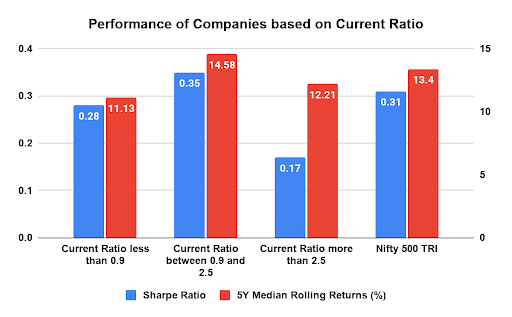
Source: NJ AMC's Internal Research, CMIE, NSE, NJ AMC's Proprietary SmartBeta Research Platform. Data is for the period 30th September 2006 to 28th February 2026. This data represents a back-tested simulation and does not represent the performance of any existing Mutual Fund scheme managed by NJ Asset Management Private Limited. Past performance may or may not be sustained and is not indicative of future returns.
Why Current Ratio Matters for Quality Investing
Quality companies are known for their resilience and their ability to withstand cycles, surprises, and economic slowdowns. But resilience is not just about long-term profitability. It also depends on whether a business can handle day-to-day financial obligations without stress.
The current ratio sits at the intersection of balance sheet strength and operational discipline. It helps answer a very practical question: if business slows down for the next six months, can the company still pay what it owes in the near term without scrambling for emergency funds?
In a quality lens:
- A company with strong liquidity doesn't need to sell assets urgently or borrow expensively to meet short-term needs.
- It has room to absorb disruptions without financial distress.
- Consistent, healthy liquidity over multiple years is often a sign of sound working capital management, which is itself an indicator of operational quality.
Think of liquidity like buffer space. Long-term profitability tells you how fast the car can travel; liquidity tells you whether the car has enough fuel and clearance to navigate a bumpy road without breaking down.
Where to Use Current Ratio and Where to Be Careful
Like all quality metrics, the current ratio must be analysed with industry context. Comparing ratios across very different business models can lead to wrong conclusions.
Where is the current ratio most useful?
- Manufacturing and Industrials: These businesses hold significant inventory and have receivables cycles. A healthy current ratio here reflects sound working capital management and the ability to absorb production-cycle delays.
- Consumer goods and FMCG companies: These often deal with distributor networks, credit periods, and inventory levels across seasons. A healthy ratio signals that they're not overextending credit or building unsaleable stock.
- Capital goods and engineering companies: These often have long project cycles and advance payments. Monitoring the current ratio helps check whether working capital is being managed sensibly across the cycle.
Where the current ratio may naturally appear different?
- Retail businesses with fast inventory turns: Large format retailers or FMCG distributors may have a structurally lower current ratio because they collect cash from customers before paying suppliers, a form of negative working capital, that actually reflects strong business dynamics. In such cases, a lower ratio is not a red flag; it's a feature of the model.
- Businesses with large advance payments from customers: When customers pay upfront (software, construction, subscriptions), current liabilities can appear high relative to assets. This inflates the denominator and can make the ratio look low, even for financially healthy businesses.
- Financial companies: The current ratio is not a reliable metric for banks and NBFCs. Their entire business model is built around borrowing short and lending long, so standard current ratio analysis doesn't apply. Ratios like capital adequacy, liquidity coverage, and net stable funding are more suitable.
A low current ratio is not automatically weak, and a high one is not automatically strong.
Conclusion
Remember the household from the introduction, well-earning, asset-rich, but short on cash when it was needed most. That gap between visible prosperity and actual near-term readiness is precisely what the current ratio helps investors spot in companies.
A quality business isn't just one that earns well over the long run; it is one that stays financially steady even when business slows, customers delay, or markets turn uncertain. The current ratio is a practical check on that steadiness.
FAQs
Q) Can a company have a high current ratio and still face financial trouble?
Yes. A high current ratio built on slow-moving inventory or receivables that are unlikely to be collected can be misleading. The ratio measures the quantity of current assets, not the quality. Always check what makes up the current assets before concluding that a high ratio means genuine strength.
Q) Is the current ratio applicable to financial companies like banks?
No. Banks and NBFCs are excluded from current ratio analysis because their business model involves borrowing short-term funds and deploying them as long-term loans.
Q) Should I use the current ratio alone to judge a company's quality?
No. The current ratio gives a snapshot of near-term liquidity. Used alongside profitability metrics (ROE, ROCE), leverage metrics (Debt-to-Equity), and cash flow analysis.
Investors are requested to take advice from their financial/ tax advisor before making an investment decision.
MUTUAL FUND INVESTMENTS ARE SUBJECT TO MARKET RISKS, READ ALL SCHEME-RELATED DOCUMENTS CAREFULLY.
« Previous Next »