
Quality Investing Simplified: Understanding OCF to EBITDA Ratio Made Simple
Introduction
Imagine you’re choosing a restaurant to visit based on its menu photos and its ambience. Everything looks premium: glossy burgers, perfect fries, sparkling desserts. But then your order arrives late, portions are smaller than promised, and the taste doesn’t match the picture. The presentation and the ambience were great, but the real experience, the part that actually feeds you, wasn’t.
In investing, EBITDA can sometimes look like that menu and ambience photo: impressive, clean, and flattering. Operating Cash Flow (OCF) is the real plate in front of you, which actually shows up in cash. And OCF to EBITDA is a simple way to check whether the business is delivering what it’s showing.
In Quality Investing, this ratio matters because quality isn’t only about what performance is reported, but it’s also about repeatable, reliable, cash-backed performance, the kind that can survive cycles, competition, and surprises.
Why OCF to EBITDA matters for Quality Investing
Quality businesses typically share a few traits: they sell something valuable, collect money on time, control costs, and reinvest sensibly, without constantly leaning on external funding. Over time, that indicates profits that are converting into cash.
That’s exactly what OCF to EBITDA tries to capture:
- Is the company’s operating performance translating into cash?
- Or is EBITDA being supported by working-capital tricks, aggressive accounting, or one-off timing benefits?
In a quality lens, good cash conversion is like good hygiene; it’s not always flashy, but you notice quickly when it’s missing.
Operating Cash Flow and EBITDA Meaning:
Operating Cash Flow (OCF):
EBITDA stands for Earnings Before Interest, Taxes, Depreciation, and Amortization. In simple terms, it shows how much the business earned from its operations before factoring in costs like interest, taxes, and non-cash charges such as depreciation and amortisation. It’s often used to compare businesses, especially when capital structures differ.
EBITDA:
Operating Cash Flow is the cash generated from the company’s core business operations (after adjusting profits for non-cash items and working capital changes). In simple words, it answers whether the business actually brings in cash from what it does every day.
Definition & formula
OCF to EBITDA: Definition
OCF to EBITDA compares operating cash flow to EBITDA to judge cash conversion.
Formula: OCF to EBITDA = Operating Cash Flow ÷ EBITDA
A quick example
- EBITDA = ₹1,000 crore
- Operating Cash Flow = ₹800 crore
- OCF/EBITDA = 0.8
A ratio of 0.8 suggests the company converted a large part of EBITDA into operating cash, but not all of it. The next step is asking: why?
Higher is better, but the real insight is not one year’s reading. The real insight is consistency across a cycle. Quality isn’t a one-quarter story.
Data Snapshot: What OCF/EBITDA looks like in practice:
| Portfolio | Annulised Return (%) | Annualised Sharpe Ratio | Annualised Volatility (%) | Maximum Drawdown (%) | Median Rolling Return (%) | |||
| 1-Year | 3-Year | 5-Year | 10-Year | |||||
| OCF to EBITDA_Top Tercile | 15.83 | 0.43 | 18.78 | -63.45 | 11.45 | 19.09 | 16.16 | 16.94 |
| OCF to EBITDA_Middle Tercile | 15.60 | 0.42 | 18.50 | -67.21 | 12.30 | 18.80 | 17.85 | 17.87 |
| OCF to EBITDA_Bottom Tercile | 9.72 | 0.21 | 22.21 | -78.24 | 5.60 | 12.37 | 10.44 | 12.00 |
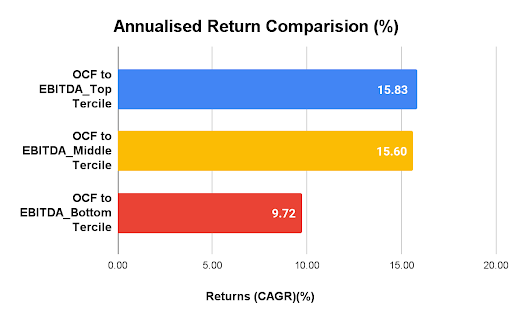
Source: Internal Research, CMIE, NJ AMC's Smartbeta Research Platform. Data is for the period 30th September 2006 to 28th February 2026. OCF to EBITDA Top, Middle, and Bottom Tercile Portfolios represent Top 33%, Middle 33% and Bottom 34% stocks respectively, based on the OCF to EBITDA parameter from Nifty 500 Universe. The analysis is carried out only on non-financial companies; financial companies are excluded. This data represents a back-tested simulation and does not represent the performance of any existing Mutual Fund scheme managed by NJ Asset Management Private Limited. Past performance may or may not be sustained in the future and is not an indication of future return.
Portfolios with higher OCF to EBITDA clearly performed better and took less downside risk. The Top Tercile delivered 15.83% annualised returns vs 9.72% for the Bottom Tercile, with lower volatility (18.78% vs 22.21%) and a smaller max drawdown (-63.45% vs -78.24%). It also showed stronger consistency across rolling periods (1/3/5/10-year medians). Overall, the data support a simple conclusion: better cash conversion tends to align with better, steadier returns.
How to read OCF to EBITDA:
If you’re checking this ratio, don’t treat it like a standalone score. Read it like a mini-story in three steps:
1) Start with the trend, not a single year
Compare 3–5 years (or longer if available). A quality business usually shows stable conversion over time, even if it fluctuates.
2) Link it to working capital movement
OCF is heavily influenced by:
- Receivables (money customers owe)
- Inventory (stock sitting in warehouses)
- Payables (money the company owes suppliers)
If EBITDA is rising but OCF is weak, the business might be “selling” but not “collecting.”
3) Cross-check with CapEx reality
Remember: OCF is before capital expenditure, but persistent low OCF/EBITDA often pairs with:
- higher working-capital needs, and/or
- heavy maintenance capex requirements
A business can look profitable but still be constantly short of cash.
Common Red Flags:
OCF/EBITDA matters most when EBITDA stays strong but cash conversion stays weak. That gap can be normal sometimes—but if it keeps repeating without an operating reason, it’s a classic earnings-quality warning.
1) Revenue inflation
What it looks like: Revenue/EBITDA up, but OCF doesn’t follow.
Why OCF/EBITDA falls: Sales are booked faster than cash comes in → receivables soak up cash.
Watch for:
- Receivables growing faster than revenue
- Rising DSO (collection days)
- Quarter-end sales spikes + weak cash after
May indicate: Early revenue booking, channel stuffing, loose credit.
Investor lens: Is the company selling—or just booking sales
2) Expense deferral
What it looks like: Margins improve fast, but OCF stays flat/weak.
Why OCF/EBITDA falls: Costs are pushed out of the P&L (capitalised, under-provided, reclassified) while cash still goes out (now or later).
Watch for:
- EBITDA up sharply, OCF flat/down
- Unusual build-up in CWIP/intangibles/other assets
- One-time adjustments that keep coming back
May indicate: Aggressive capitalisation, delayed provisions, earnings management.
Investor lens: Real margin gains show up in cash—accounting timing usually doesn’t.
3) Inventory / COGS manipulation
What it looks like: EBITDA stable/improving, but cash gets trapped in working capital.
Why OCF/EBITDA falls: Inventory build ties up cash; aggressive inventory accounting can flatter margins.
Watch for:
- Inventory is rising faster than sales
- Increasing inventory days
- Gross margins are improving without a clear driver
- Frequent changes in inventory costing/valuation
May indicate: Demand slowdown/overproduction, delayed write-downs, costs parked in inventory.
Investor lens: When inventory piles up, cash conversion is usually the first crack.
Industry Context:
This ratio must be read with industry context; investors risk rejecting good businesses or accepting weak ones.
Where OCF/EBITDA is usually strong
- Asset-light, service-oriented models with fast collections
- Consumer brands with strong pricing power and quick inventory turns
- Subscription / annuity-like businesses (often) with predictable receipts
- Businesses with negative working capital (customers pay early, suppliers are paid later)
Where it may be structurally lower / volatile
- Working-capital heavy sectors (inventory + receivables are large)
- Project-based models (cash comes in milestones; EBITDA may be smoother than cash)
- Highly seasonal industries (one bad timing quarter can distort OCF)
- Businesses in an investment phase (expanding distribution, building inventory, entering new geographies)
So a low ratio is not automatically low quality. The key is:
Is the weakness explainable, repeatable, and improving, or is it masking fragility?
How NJ AMC uses it:
At NJ AMC, a quality-focused, rule-based approach typically prefers signals that are:
- measurable,
- repeatable, and
- difficult to fake for long.
This ratio fits well because it directly tests whether operating performance is backed by cash. In a rule-based quality lens, it can be used as:
- A cash-conversion screen to avoid businesses where earnings don’t translate into operating cash.
- A consistency check, because sustained quality usually shows sustained conversion.
- A companion to other quality markers (profitability, balance-sheet prudence, and governance comfort), rather than a standalone decision-maker.
In simple terms, it helps separate good-looking numbers. It is better used for eliminating the bottom-ranking companies. Usually, higher is better, but a low ratio is a clear red flag.
Conclusion
Let’s go back to the restaurant analogy. A glossy menu isn’t irrelevant; it sets expectations. But if the food doesn’t arrive the way it was promised, you’d be right to question the place.
OCF to EBITDA is a quick reality check: did the business deliver real cash from real operations, year after year?
For quality-focused investors, that’s a big deal, because long-term compounding works best when the underlying business is not just reporting performance, but funding itself through cash-generating strength. And that’s the kind of quality that doesn’t just look good on paper; it holds up when the market mood changes.
FAQs
Q) What is a good OCF to EBITDA ratio?
There isn’t one universal number. Many stable businesses often land around 0.7 to 1.0 over time, but what matters most is consistency and industry context.
Q) Can OCF/EBITDA be above 1? Is that always great?
It can be strong, but check whether it’s driven by a one-time working-capital release. If it’s repeatable and supported by operations, it’s positive.
Q) Why can EBITDA be strong while cash flow is weak?
Common reasons include rising receivables, inventory build-up, delayed collections, or accounting effects that recognize revenue earlier than cash comes in.
Investors are requested to take advice from their financial/ tax advisor before making an investment decision.
MUTUAL FUND INVESTMENTS ARE SUBJECT TO MARKET RISKS, READ ALL SCHEME -RELATED DOCUMENTS CAREFULLY.
« Previous Next »