
Quality Investing Simplified: What is ROCE?
Introduction
Picture a market where two stalls sell the same best-selling dish. Customers line up for both. From the outside, both look equally successful. But when you look behind the counter, the difference is obvious: one stall runs with a simple setup and minimal equipment, while the other needs heavy machinery, a larger space, and higher daily costs, so ROCE becomes the real test of who’s running a smarter, more efficient setup.
This is the same difference you often see between two companies that report similar profits. One company may require much more money tied up in factories, inventory, and working capital to generate those profits, while another achieves similar results with much less. ROCE (Return on Capital Employed) captures this efficiency.
ROCE measures the operating profit (EBIT) a company generates per rupee of capital employed. For anyone focused on quality investing, ROCE becomes a practical way to separate a good-looking business from a business that is genuinely efficient and scalable.
Why ROCE Matters
In quality investing, we’re not only looking for growth. We’re looking for businesses that can grow without constantly needing huge amounts of fresh capital.
ROCE matters because it highlights three powerful realities:
- Capital efficiency: Some businesses convert capital into profits better than others.
- Competitive strength: Companies with strong brands, pricing power, efficient operations, or a moat often show higher ROCE over time.
- Better compounding potential: If a company earns high returns on capital and can reinvest at similar rates, it can compound value steadily.
In simple words, ROCE is a quality filter that checks whether profits are being earned the smart way.
Definition
ROCE (Return on Capital Employed) tells you how efficiently a company uses the money invested in the business to generate operating profit, which is basically how much operating profit it earns for every ₹1 of capital it uses.
- Return = operating profit (usually EBIT)
- Capital employed = the long-term money used to run the business (equity + long-term debt, and broadly the capital locked in assets/working capital)
A consistently healthy ROCE can signal a business that’s well-run and structurally strong, which is exactly what quality-focused investors typically look for.
Simple Formula: How to Calculate ROCE
ROCE Formula
ROCE = EBIT ÷ Capital Employed
Step 1: Find EBIT
EBIT = Earnings Before Interest and Taxes
Investors can think of EBIT as operating profit, before the impact of financing (interest) and taxes. This helps compare companies on business performance rather than funding choices.
Step 2: Find Capital Employed
There are two common ways:
Method A (Balance-sheet approach):
Capital Employed = Total Assets − Current Liabilities
This roughly captures the long-term funds used in the business.
Method B (Funding approach):
Capital Employed = Equity + Long-term Debt
Let’s Understand With An Example:
Suppose a company XYZ Ltd has:
- EBIT = ₹200 crore
- Total Assets = ₹1,500 crore
- Current Liabilities = ₹500 crore
Then:
Capital Employed = 1,500 − 500 = ₹1,000 crore
Now ROCE:
ROCE = 200 ÷ 1,000 = 0.20 = 20%
What does 20% ROCE mean?
In simple terms, for every ₹100 the business had tied up in the company, it earned about ₹20 in operating profit during that period.
Interpretation: What’s a Good ROCE?
ROCE is not a single magic number, but here’s a practical way to interpret it:
1) Compare to the company’s own history
- Is ROCE improving over 5–10 years?
- Is it stable through market cycles?
Consistency is often more meaningful than one standout year.
2) Compare to peers in the same sector
A 15% ROCE might be excellent in a capital-heavy sector, but average in an asset-light one.
3) Compare to the cost of capital
If a company earns returns meaningfully above its cost of capital, it’s likely creating value. If ROCE hovers too low, it may be working hard just to stand still.
4) Watch the quality of the ROCE
A high ROCE is better, but also ask why it is high:
- Is it due to strong margins and pricing power?
- Or is it because the company has underinvested and assets are aging?
The second can look good temporarily, but may hurt later.
Where ROCE Works Best: Sectoral Comparison
ROCE becomes most insightful when the capital story matters, which means that the business needs meaningful investment in plants, inventory, distribution, or working capital.
ROCE works best in:
1) Manufacturing and Industrials
Factories, machinery, and working capital needs are real. ROCE quickly shows who runs assets efficiently.
2) Consumer businesses (FMCG, retail formats, branded players)
Strong distribution, brand moat, and pricing power can lead to stable, healthy ROCE over time.
3) Infrastructure, utilities, telecom (with caution)
Capital is heavy and cycle-based. ROCE helps compare operators—but you must also watch debt and regulation.
4) Auto ancillaries and capital goods (with cycle awareness)
ROCE can look fantastic at cycle peaks and compress in downturns. Multi-year averages matter.
ROCE is best used for non-financial companies because capital employed is clearly defined through operating components like fixed assets and working capital, funded by equity and debt. In financials, money itself is the product, so capital employed isn’t comparable, therefore making ROCE less reliable.
Let’s understand this through the data:
| Portfolio | Annualised Return (%) | Annualised Sharpe Ratio | Annualised Volatility (%) | Maximum Drawdown (%) | Median Rolling Return (%) | |||
| 1-Year | 3-Year | 5-Year | 10-Year | |||||
| ROCE Top Tercile | 15.00 | 0.42 | 16.57 | -61.6 | 19.92 | 17.91 | 17.4 | 17.21 |
| ROCE Middle Tercile | 13.19 | 0.33 | 20.64 | -72.77 | 19.78 | 15.58 | 14.51 | 14.53 |
| ROCE Bottom Tercile | 11.02 | 0.27 | 23.55 | -76.41 | 18.54 | 12.92 | 11.26 | 10.15 |
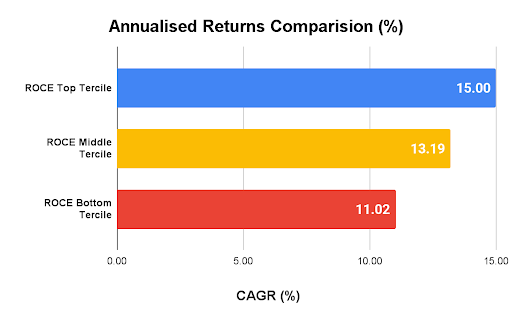
Source: Internal Research, CMIE, NJ AMC's Smartbeta Research Platform. Data is for the period 30th September 2006 to 31st January 2026. ROCE Top, Middle, and Bottom Tercile Portfolios represent Top 33%, Middle 33% and Bottom 34% stocks respectively, based on the ROCE parameter from Nifty 500 Universe. Financial companies are excluded; the portfolio analysis includes only non-financial companies. Past performance may or may not be sustained in the future and is not an indication of future return.
- Top ROCE tercile leads on returns: It delivers the highest annualised return (15%) versus middle (13.19%) and bottom (11.02%).
- Better risk-adjusted performance: The top tercile also has the best Sharpe (0.42), indicating stronger return per unit of risk than the middle (0.33) and the bottom (0.27).
- Lower volatility & smaller losses: Top tercile is less volatile (16.57%) and has a relatively lower max drawdown (-61.6%) compared to middle (20.64%, -72.77%) and bottom (23.55%, -76.41%).
- More consistent long-term outcomes: Median rolling returns remain strongest for the top tercile across horizons (1Y 19.92, 3Y 17.91, 5Y 17.4, 10Y 17.21), showing steadier compounding versus middle and bottom groups.
Common ROCE Traps
ROCE is powerful, but it can mislead if you don’t watch the fine print.
1) One-year ROCE glory.
A single strong year (commodity upcycle, temporary margin expansion) can inflate EBIT and ROCE. Look for consistency, not just a spike.
2) Ignoring balance sheet risk
A company can post strong ROCE and still carry heavy debt or weak liquidity. Always pair ROCE with leverage checks like Debt-to-Equity and interest coverage.
3) Accounting and EBIT quality
ROCE uses EBIT, so one-time gains, reclassification, or unusual items can distort the real operating profit.
4) Underinvestment that looks like efficiency
If a company cuts back on essential spending like maintenance capex, its numbers can look better in the short run, and so ROCE may go up because it’s spending less. But over time, assets wear out, performance slips, and the business can lose its edge.
5) Negative or unusual capital employed
Some businesses can show odd numbers if current liabilities are unusually high or due to the accounting structure. In such cases, ROCE may become confusing to analyze and needs deeper analysis.
6) Comparing across sectors
A software firm and a cement firm live in different capital worlds. Comparing their ROCE directly can create wrong conclusions.
Conclusion:
Think back to those two market food stalls. Stall A looked smarter because it earned well with less setup. But before you invest, you’d still check other things: Is the food consistently good? Is the stall owner reliable? Are customers loyal? Is there debt taken for expansion?
That’s the right way to use ROCE in investing, too. ROCE is a brilliant capital-efficiency lens, but it works best when combined with other quality parameters, such as:
- ROE (Return on Equity) for shareholder profitability
- Debt-to-Equity and interest coverage for balance-sheet strength
- Cash flow consistency (profits should convert to cash over time)
- Margin stability and earnings consistency across cycles
- Governance and capital allocation discipline (how management reinvests, expands, or returns capital)
Used this way, ROCE becomes more than a formula. It becomes a practical tool to separate headline profitability from true business quality, so investors can back businesses that don’t just earn, but earn efficiently and sustainably.
FAQs
Q) What is ROCE in simple terms?
ROCE shows how efficiently a company generates operating profit using the total long-term capital invested in the business.
Q) What is a good ROCE range?
It depends on the sector. A good ROCE is typically one that is strong versus peers and stable over multiple years.
Q) Should investors use ROCE alone for stock selection?
No. Use ROCE with other quality parameters like ROE, debt levels, cash flows, and consistency across cycles.
Investors are requested to take advice from their financial/ tax advisor before making an investment decision.
MUTUAL FUND INVESTMENTS ARE SUBJECT TO MARKET RISKS, READ ALL SCHEME RELATED DOCUMENTS CAREFULLY.
« Previous Next »