
The World is Investing in Quality Factor. Have You?
Introduction
Imagine planning your financial future like a long road trip. You can choose the scenic, adventurous, but unpredictable route, which is full of sharp turns, sudden stops, and frequent surprises, or take the smooth expressway built to endure all seasons. As an investor, this is the confusion you face every day: Should you chase short-term performance or stay invested with quality factor investments, which are designed to create wealth over the long term?
In recent years, an increasing number of investors have chosen the latter. They’re focusing not on catchy market themes, but on the quality, which has companies with strong fundamentals, dependable earnings, and resilient business models. This isn’t just a trend; it’s a powerful shift shaping how long-term portfolios are constructed.
What Is the Quality Factor?
In factor investing, the quality factor refers to a systematic way of identifying companies with a strong balance sheet, high and consistent ROE, high and consistent dividend payout, and low debt, along with strong governance. While other factors, such as momentum or value, capture different traits of market behavior, quality focuses on resilience and sustainability, which possess fantastic characteristics, particularly valuable in uncertain times, and create wealth over a period of time.
USA Context: Quality Gaining Ground in Developed Markets
Let’s take a quick look at the data from the US smart beta market, now valued at over $2.8 trillion in AUM (as of Dec 2025).
| Factor | Factor-wise Growth over the Last Decade | |||||
| Number of Factor-Based ETFs | Equity Smart Beta AUM | |||||
| No. of factor-based ETFs in 2015 | No. of factor-based ETFs in 2025 | Growth | AUM as of 31st December 2015 (In US$ million) | AUM as of 31st December 2025 (In US$ million) | AUM Growth | |
| Quality | 12 | 62 | 17.85% | 5,586.13 | 142,413.52 | 38.24% |
| Value | 48 | 125 | 10.04% | 98,957.10 | 656,584.10 | 20.83% |
| Momentum | 26 | 35 | 3.02% | 5,905.24 | 56,159.81 | 25.26% |
| Low Volatility | 29 | 52 | 6.01% | 24,528.04 | 62,024.42 | 9.72% |
| Size | 57 | 60 | 0.51% | 32,247.20 | 166,436.34 | 17.84% |
| Growth | 35 | 103 | 11.40% | 114,497.92 | 807,142.98 | 21.57% |
| Multi-factor | 118 | 189 | 4.82% | 41,872.17 | 286,504.35 | 21.21% |
| Others | 115 | 400 | 13.28% | 129,060.11 | 667,415.93 | 17.86% |
| Total | 440 | 1026 | 8.84% | 452,653.90 | 2,844,681.46 | 20.18% |
Source: Bloomberg Intelligence
- The number of Quality ETFs grew from just 12 in 2015 to 62 in 2025, a 17.85% rise, outpacing most other factors.
- More impressively, the AUM in Quality ETFs surged from $5.59 billion to $142.41 billion, reflecting a massive 38.24% growth, which is the highest among all listed factors.
This indicates that investors are increasingly prioritizing quality as a core long-term strategy, thanks to its proven resilience and strong performance.
Once seen as a niche lane on the investment highway, quality investing has now become the main route for many long-term investors. In 2015, there were only 12 Quality ETFs in the U.S. However, by 2025, that number had grown to 62, which provides a clear signal that more travelers are choosing the road built for endurance.
And it’s not just about more vehicles on the adventurous route; it’s about the strength of a smooth journey itself, which provides a comfortable experience.
- AUM grew from USD 5.59 billion in 2015 to USD 142.41 billion in 2025.
- The acceleration after COVID marks a turning point for the quality factor in the US, a shift in how investors choose their path: with more focus on resilience, reliability, and long-term direction.
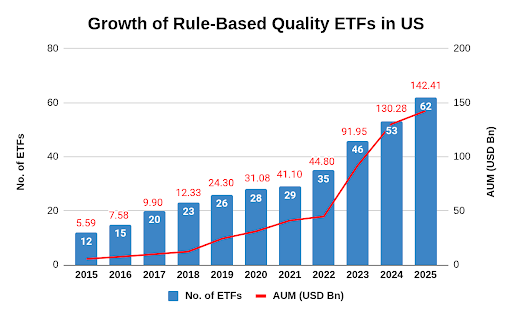
Source: NJ AMC's Internal Research, Bloomberg Intelligence. Data for each year from 2015 to 2025 are as of 31st December. Past data may or may not be sustained in the future.
The Indian Context: Quality Awakening at Home
India hasn’t lagged behind this movement. Take a look at how quality-focused rule-based investment vehicles have evolved over the past few years:
- In 2019, India had only one quality-oriented ETF with AUM of roughly ₹18 crore.
- By 2025, that number surged to 32 quality ETFs with a combined AUM of ₹4,956 crore and growing.
Long-term performance supports this adoption:
Since 2005, quality strategies have delivered around 19% annualised returns, significantly outpacing broad-market averages.
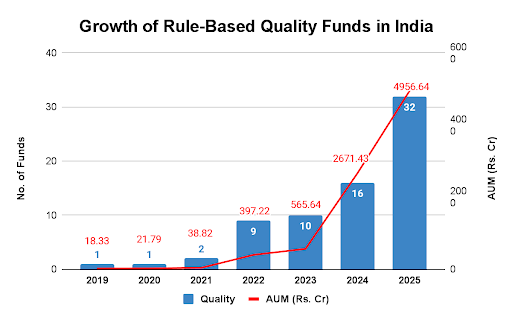
Source: ICRA, NJ AMC's Internal Research. Data for each year from 2019 to 2025 is as of 31st December. Quality-oriented funds refer to those funds that focus on the quality factor alone, as well as combined with other factors. Past data may or may not be sustained in the future.
This demonstrates not just short-term demand but a lasting structural shift in investor preferences for a smooth financial journey of long-term wealth creation.
A Real Example: What Quality Looks Like in Action
To understand the real power of quality, consider this data comparison between three portfolios: a High Quality Model, a Low Quality Model, and the Nifty 500 TRI.
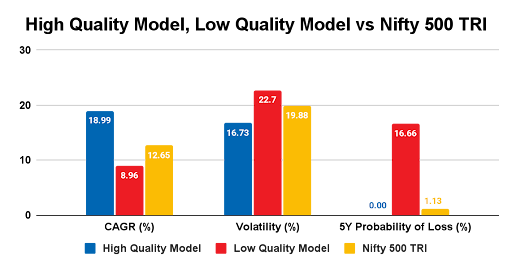
Source: NJ AMC's Internal Research, CMIE, NSE, NJ AMC's ProprietarySmartBeta Research Platform. Data is for the period 30th September, 2006 to 30th November, 2025. High Quality Model is represented by NJ Quality+ Model. NJ Quality+ Model and Low Quality Model are proprietary methodologies developed by NJ Asset Management Private Limited The methodology wil keep evolving with new insight based on the ongoing research and will be updated accordingly from time to tima 5Y Probability of Loss (9%) reprasents the percentage of negative retum observations across all 5-year rolling retum periods, where returns are calculated on a daily rolling basis. Past performance may or maynot be sustained in future and is not an Indication of future return.
As per the past data:
-
The High Quality Model delivered the highest returns (18.99% CAGR), with lower volatility than both the Low Quality and the Nifty 500 index.
-
Most importantly, it had a zero probability of loss over 5 years, underscoring its long-term strength and resilience.
-
In comparison with the High Quality Model, the Low Quality Model not only delivered the lowest returns (8.96%) but also had the highest volatility and risk of loss (16.77% over 5 years).
This reinforces the core message of quality investing: you don’t need to sacrifice returns for stability. In fact, high-quality portfolios offer a dual advantage: superior performance and lower emotional stress over time due to uncertain market movements.
Why Quality Factor Investing Is Gaining Investor Confidence
Many forces are driving the shift toward quality:
- Market volatility is the new normal: Geopolitical tensions, economic slowdowns, and rapid policy shifts have made markets more unpredictable. In such kind of environments, quality stocks often display lower drawdowns and faster recoveries.
- Investor awareness is rising: This is due to the easy access to research and factor data; investors are becoming increasingly aware of the long-term benefits of quality-oriented strategies over short-term speculation.
- Technological advancements in investing platforms: Algorithmic and smart beta portfolios now often include quality filters as a core component, making it easier for investors to adopt these strategies.
- Institutional adoption: Pension funds, insurance companies, endowments, and sovereign wealth funds, along with traditionally conservative allocator,s are embedding quality factors into their portfolios to better manage risk and long-term liabilities.
Conclusion
If you're tired of the ups and downs of the market, quality investing offers a steadier path; one that’s built for long-term success, not short-term thrills. This shift isn’t about chasing the next big thing. It’s about focusing on what truly lasts, because when it comes to building wealth, it’s not about being fast, but it’s about staying invested.
For anyone thinking of staying invested over the years to come and not just for the short term to build wealth, the quality factor is a smart and reliable way to invest for the future.
FAQs
Q) How does quality differ from other factors like momentum or value?
Quality focuses on financial strength and performance consistency, whereas momentum tracks recent price trends, and value looks at relative cheapness.
Q) Can quality investing reduce emotional investing mistakes?
Yes, because it encourages long-term holding and minimises reactive trading during market stress.
Q) Does quality outperform in all market conditions?
Quality doesn't outperform in every brief market phase. It typically delivers more consistent and stable returns with lesser volatility across market cycles over a long period of time.
Investors are requested to take advice from their financial/tax advisor before making an investment decision.
MUTUAL FUND INVESTMENTS ARE SUBJECT TO MARKET RISKS. READ ALL SCHEME RELATED DOCUMENTS CAREFULLY.
« Previous Next »