
Quality and Low Volatility: Built for Stability, Made to Win
Imagine driving a car. A well-tuned suspension gives you a smooth, bump-free ride, and the road feels calm and predictable. But what truly determines how far the car can take you is the strength of its engine. A powerful, well-built engine keeps performing year after year, even if the road isn't always perfect. Both the smooth suspension and the strong engine make the journey feel safe, so at first sight, they might seem similar. But they serve completely different purposes.
Investing works the same way. Low volatility investing offers a smoother ride with fewer price movements, while quality investing focuses on portfolios built with financially sound businesses along with strong governance, which is designed to endure. They may feel the same, but they are fundamentally different strategies based on different foundations.
Understanding the difference between the two can help investors choose an approach that truly supports their long-term goals.
What is low volatility investing?
For a better understanding, think of low volatility investing as choosing a well-paved, stable road instead of a steep, winding mountain path full of sharp turns and drops. The mountain route may offer more thrill and spectacular views, but it also comes with a higher risk of accidents. The well-paved road, on the other hand, offers a smoother and safer journey, just like low volatility factor investing.
Low volatility investing focuses on constructing portfolios that experience less volatility and lesser drawdowns over time. Such portfolios typically:
- Demonstrate lesser price fluctuations over time
- Protect better during market downturns, falling less when markets correct
- Deliver more stable and predictable returns
The idea behind low volatility investing is simple: by minimizing large losses, investors can support long-term compounding and enjoy greater emotional comfort, making it easier to stay invested through different market cycles.
What is quality investing?
Quality investing focuses on building portfolios made up of companies with strong financial foundations and durable business models. Just as a car relies on a powerful, reliable engine to keep performing over long distances, a quality-focused portfolio depends on fundamentally strong businesses to drive long-term returns. The objective is to create a portfolio that can withstand economic uncertainty and continue compounding, regardless of short-term market noise.
Quality-focused portfolios typically:
- Allocate to companies with robust balance sheets
- Favour businesses delivering high and consistent return on equity (ROE)
- Prefer companies with stable earnings
- Prefer companies with lower debt-to-equity
- Seek sustainable long-term growth supported by strong competitive advantages
This approach centres on portfolio resilience. By focusing on companies with durable financial and business strength, quality investing aims to hold businesses that can weather market shocks, maintain profitability, and steadily create wealth over time.
Why Investors Often Confuse the Two
Many investors tend to label both low volatility and quality investing as safe, but that’s a mental shortcut. Our brains often equate calm with strength. So, when a portfolio shows fewer ups and downs, we assume it must also be fundamentally sound. This is an example of representativeness bias.
But the reality holds something different:
- A low-volatility portfolio may include companies with weaker fundamentals
- A quality portfolio may show more short-term fluctuations despite strong underlying businesses
Understanding this bias helps investors make clearer decisions regarding risk and return.What complicates matters is that the two have historically moved together, showing a correlation of about 0.83.This has led many investors to treat them as near substitutes. But in reality, they aren’t, and the difference is more meaningful than it first appears.
Why Understanding the Difference Matters
Treating the two as the same can lead to:
- Misaligning their portfolio strategy with their actual goals
- Overlooking strengths unique to each factor
- Overlapping risk exposures
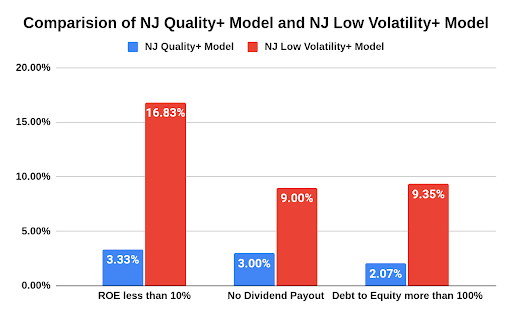
Source: CMIE, NJ Asset Management Private Limited Internal Research, and NJ’s Smart Beta Platform (an in-house proprietary model of NJ AMC). Calculations are for the period 30th September 2020 to 30th November 2025. Debt to Equity is calculated on non-lending companies. NJ Quality+ Model and NJ Low Volatility+ Model are in-house proprietary methodologies developed by NJ AMC. These methodologies are dynamic in nature and will continue to evolve with ongoing research and insights, and may be updated from time to time. Past data may or may not be sustained in the future and is not an indication of future return.
The chart shows that the NJ Low Volatility+ Model has significantly higher exposure to financially weaker companies—16.83% of its stocks have ROE below 10% (vs 3.33% in Quality+), 9.00% pay no dividends (vs 3.00%), and 9.35% have debt-to-equity above 100% (vs 2.07%). This highlights that while low volatility portfolios may offer smoother price movements, they can still include weaker businesses, whereas the Quality+ Model largely avoids such fundamentals and focuses on stronger, more resilient companies.
Where Strength Meets Stability: The Power of Combining Both
The data shown below highlights an interesting insight: portfolios that combine the Quality and Low Volatility factors doesn’t just look safer but also have performed better across multiple time periods. This combination of resilience and consistency delivers a dual benefit: smoother returns in turbulent times and stronger compounding over the long run.
| Portfolio | Annulised Return (%) | Sharpe Ratio | Annualised Volatility (%) | Maximum Drawdown (%) | 3Y Loss Probability (%) | Median Rolling Return (%) | |||
| 1-Year | 3-Year | 5-Year | 10-Year | ||||||
| High Quality Low Volatile Stocks | 20.20 | 0.78 | 13.27 | -41.91 | 0.32 | 16.76 | 23.26 | 23.62 | 20.72 |
| High Quality High Volatile Stocks | 18.01 | 0.48 | 22.13 | -68.89 | 6.93 | 14.75 | 18.89 | 16.44 | 17.67 |
| NJ Quality+ Model | 19.14 | 0.59 | 16.75 | -59.05 | 1.05 | 15.76 | 21.86 | 19.60 | 19.86 |
| NJ Low Volatility Model | 17.64 | 0.60 | 14.39 | -52.63 | 0.53 | 14.96 | 19.30 | 17.98 | 18.03 |
| Nifty 500 TRI | 12.73 | 0.32 | 19.92 | -63.71 | 3.98 | 10.92 | 13.52 | 13.23 | 13.49 |
Source: CMIE, NJ Asset Management Private Limited Internal Research, and NJ’s Smart Beta Platform (an in-house proprietary model of NJ AMC). Calculations are for the period 30th September 2006 to 30th November 2025. High Quality Low Volatile Stocks and High Quality High Volatile Stocks represent the top and bottom tercile low volatility stocks, respectively, based on Quality from NJ Quality+ Model. NJ Quality+ Model and NJ Low Volatility Model are in-house proprietary methodologies developed by NJ AMC. These methodologies are dynamic in nature and will continue to evolve with ongoing research and insights, and may be updated from time to time. Past data may or may not be sustained in the future and is not an indication of future return.
Conclusion
Just like the two commuting routes, where one is smooth, and the other is reliable, low volatility, and quality are both appealing, yet meaningfully different. Low volatility offers stability through gentle price movements, while quality delivers resilience through strong fundamentals.
Confusing the two due to behavioural shortcuts is natural, but understanding their differences helps make better portfolio decisions to create long-term wealth.
And in the long run, choosing the right route, or even combining both, can make an investor’s investing journey far more rewarding.
FAQs
Q) Is low volatility the same as low risk?
Not always. A low volatility portfolio may still be exposed to sector or concentration risks.
Q) Can quality portfolios be volatile?
Yes. Strong underlying companies can still experience market-driven volatility.
Q) Does combining both factors improve a portfolio?
Yes. They complement each other by addressing different types of risks.
Investors are requested to take advice from their financial/ tax advisor before making an investment decision.
MUTUAL FUND INVESTMENTS ARE SUBJECT TO MARKET RISKS, READ ALL SCHEME RELATED DOCUMENTS CAREFULLY.
« Previous Next »