
Quality Investing Simplified: What Is Dividend Payout Ratio?
Introduction
Imagine managing your monthly income. You receive your salary, pay for your living expenses, and ideally set aside a portion for future goals or emergencies. Now think: if you spent almost all of your salary every month, wouldn’t that put your plans at risk? But if you saved everything and never used your income, wouldn’t you feel deprived in the present? This is exactly how a company manages its profits. In the world of quality investing, how a company uses its profits, whether to share them or reinvest them, matters deeply. The portion it shares with investors is called a dividend, and the dividend payout ratio reflects how much of its earnings the company distributes versus how much it retains for growth. Just like personal finance, it's a balancing act.
That’s exactly what the dividend payout ratio helps investors understand in investing. In quality investing, you’re not just impressed by a company that pays dividends. You also want to know: Is this dividend sustainable? Is it sensible? Is it a sign of strength or is it a sign of strain?
In this article, investors will understand what the dividend payout is, how to read it simply, why it matters for quality investing, and how to use it without falling into common traps.
What is the Dividend Payout Ratio?
The dividend payout ratio shows investors the portion of a company’s profits paid out to shareholders as dividends.
Simple Dividend Payout Ratio Formula:
Dividend Payout Ratio = Dividend per Share (DPS) ÷ Earnings per Share (EPS)
Example:
If a company earns ₹100 per share and pays ₹30 as a dividend, the payout is 30%. It means that it returned 30% of profits to shareholders and kept 70% inside the business.
In simple terms, it answers one big question:
How much is the company sharing today, and how much is it saving to grow tomorrow?
A higher dividend payout is better because it usually reflects a company that’s genuinely doing well, it’s earning enough, generating steady cash, and still has the confidence to share a bigger portion of profits with shareholders. Think of it like a household that comfortably pays all its bills and still has surplus left to give back, which is what that extra room signals: stability. So when a company maintains a higher payout without stretching itself, it often points to a stronger, healthier business with disciplined money management.
Why Does Dividend Payout Ratio Matter in Quality Investing?
Quality investing is about companies that can endure with steady cash flows, strong balance sheets, sound management decisions, and the ability to be consistent through cycles. The ratio fits beautifully into this mindset because it often reflects capital discipline. A quality company often treats dividends like a commitment, not a marketing campaign. It aims for a payout that it can maintain even when business conditions may not be favourable in that period. That typically means:
- Dividends are paid from real, recurring earnings and not from temporary spikes.
- Payouts are consistent or gradually rising, instead of random.
- The company still retains enough profits to reinvest in operations, innovation, and balance sheet strength.
Even here, higher is better but only when it’s real and sustainable. A high dividend looks attractive, but if it’s being kept high just for optics, it can do more harm than good. When a company pays out too much, it may end up cutting back on growth investments or using dividends to distract from weak business performance. So the goal isn’t just a higher dividend, but a higher-quality dividend that the company can comfortably maintain.
Here’s how it matters:
1) It tells investors if the dividend is sustainable
A higher payout is better when it’s supported by steady profits, and the payout ratio tells you exactly that. If the ratio is high, it signals the company can reward investors without putting the dividend at risk during a weak year.
2) It shows how the company balances today’s rewards and future growth
It helps investors see how much the company is giving back today, and how much it’s keeping to grow stronger tomorrow.
3) It helps investors understand the company’s stage of growth
Young, growing companies usually reinvest more and pay less. Mature companies with stable earnings often pay more. It helps investors spot which one they’re dealing with.
4) Separates high-quality dividends from flashy ones
A high dividend is great, but if it’s affordable. The payout ratio helps you tell the difference between a high-quality, high payout and a “too-good-to-be-true” dividend that may be cut later.
5) It supports better quality checks
Used with other metrics like debt, cash flow, and profit stability, the ratio helps confirm whether a company’s dividend and business are truly healthy and sustainable.
What the Data Shows About the Dividend Payout Ratio:
| Portfolio | Annualised Return (%) | Annualised Sharpe Ratio | Annualised Volatility (%) | Maximum Drawdown (%) | Median Rolling Return (%) | |||
| 1-Year | 3-Year | 5-Year | 10-Year | |||||
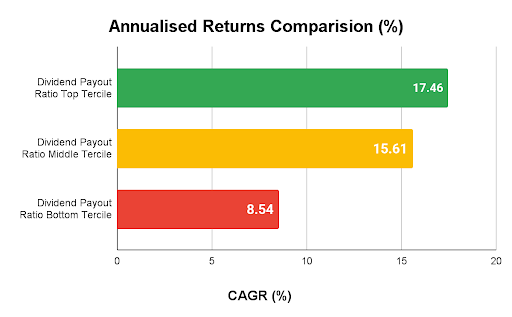
| Dividend Payout Ratio Top Tercile | 17.46 | 0.49 | 17.98 | -64.33 | 22.79 | 19.85 | 18.42 | 17.88 |
| Dividend Payout Ratio Middle Tercile | 15.61 | 0.4 | 20.59 | -69.06 | 21.28 | 17.57 | 16.61 | 16.59 |
| Dividend Payout Ratio Bottom Tercile | 8.54 | 0.18 | 22.93 | -77.67 | 15.06 | 9.32 | 8.00 | 7.40 |
Source: Internal Research, CMIE, NJ AMC's Smartbeta Research Platform. Data is for the period 30th September 2006 to 31st December 2025. Dividend Payout Top, Middle, and Bottom Tercile Portfolios represent Top 33%, Middle 33%, and Bottom 34% stocks respectively, based on the Dividend Payout parameter from Nifty 500 Universe. Loss-making companies are excluded from the definition. Past performance may or may not be sustained in the future and is not an indication of future return.
The data clearly shows that companies in the top tercile of dividend payout ratio delivered the best performance across almost all metrics. With an annualised return of 17.46%, the highest Sharpe ratio (0.49), and the lowest volatility (17.98%) among the three groups, they not only rewarded shareholders but did so with greater consistency and lower risk.
Their median rolling returns across 3, 5, and 10 years also remained robust and stable. In contrast, companies in the bottom tercile, which paid the least in dividends, had the weakest performance, only 8.54% returns, higher volatility, and the steepest drawdowns. The middle tercile offered balanced performance but still lagged behind the top group.
This suggests that a sensible, consistent dividend payout often aligns with better quality and stronger long-term returns by supporting the idea that dividend discipline is a useful marker in quality investing.
Strategies to Use Dividend Payout Ratio Wisely in Quality Investing
1) Don’t judge the number without the story
A 60% payout might be sensible for a stable consumer business, but alarming for a cyclical company whose earnings swing wildly. Always ask: How stable are profits? The more volatile the earnings, the more cautious investors should be about a high payout.
2) Watch for consistency, not perfection
Quality is often visible in patterns. A ratio that stays within a reasonable band over time (even if it’s not the ideal number) can be a healthier sign than a ratio that jumps from 20% to 90% to 10%. Consistency often signals planning.
3) Check if dividends are backed by cash, not just accounting profits
EPS is useful, but dividends are paid in cash. If a company shows profits but struggles to generate cash, dividends become harder to sustain. If investors want a simple mental model, earnings are a promise; cash is the proof.
4) Beware of one-time payouts
Sometimes a company sells an asset, books a one-time profit, and pays a large dividend. That can temporarily spike the payout or make it look generous. For quality investing, the key question is: Can this happen again next year without selling another piece of the house?
5) Combine payout ratio with growth logic
A payout ratio should make sense with the company’s growth strategy. If the company says it has huge expansion plans but pays out most of its earnings, investors should wonder: How will it fund growth by using more debt, dilution, or cutting dividends?
6) Use it as a guardrail, not a single-point decision
The dividend payout ratio is one indicator. Quality investing is rarely about one metric. Think of it like health: a single blood test doesn’t define fitness, but it can raise useful flags. Pair payout ratio with diversification in investors' portfolio thinking, and avoid building a strategy that relies on only one type of signal.
Conclusion
Much like managing personal income, a company’s use of profits reflects its financial maturity. The dividend payout ratio is a simple but powerful lens to understand this. It shows whether a business is spending wisely, saving for growth, or risking its future by overpaying today.
For investors focused on quality, long-term growth, and sensible income, learning to read the ratio accurately can help avoid emotional decisions and stay anchored to strategy. In the end, it’s not about how much is paid but how well it’s balanced.
In quality investing, the goal isn’t to chase the biggest dividend headline. It’s to identify businesses that can keep performing, keep compounding, and keep rewarding shareholders in a way that makes long-term sense. Read the payout ratio like a story about balance: reward today, resilience tomorrow.
FAQs
Q1) What is a good dividend payout ratio?
A good dividend payout ratio depends on the business type. Stable, mature companies can sustain higher payouts, while fast-growing or cyclical businesses may need lower payouts to reinvest and manage downturns.
Q2) Is a higher dividend payout ratio always better for investors?
Not always. A very high payout ratio can mean the company has less room to reinvest or handle earnings drops. Sustainable dividends matter more than large dividends.
Q3) How should long-term investors use the dividend payout ratio?
Investors can use it as a filter for sustainability and management discipline, not as the only decision factor. Combine it with fundamentals and a long-term approach (Staying Invested often matters more than chasing short-term dividend signals).
Investors are requested to take advice from their financial/ tax advisor before making an investment decision.
MUTUAL FUND INVESTMENTS ARE SUBJECT TO MARKET RISKS, READ ALL SCHEME RELATED DOCUMENTS CAREFULLY.
« Previous Next »