
NJ Momentum Fund: A Complete Guide to Momentum Investing with Quality
Rohan has been investing for a few years. He doesn't track the market every day, but he does notice when a stock keeps gaining attention because its price has been rising steadily. And that leaves him with a familiar dilemma: If the stock has already gone up so much, is it still worth buying?
It sounds like a simple question. But the answer takes us to an interesting concept in factor investing: Momentum.
What Is the Momentum Factor?
Think about a cricket team that has won its last five matches. The team is in rhythm. The players are confident. Things are working. Does that guarantee that they will win their next match? Of course not.
But the winning streak does tell us something about their current form. A similar idea exists in the stock market. The Momentum Factor focuses on stocks that have performed strongly in the recent past, based on the idea that this strength may continue for a period of time.
In simple terms: Momentum Investing looks for stocks that are showing strength and a strong trend. But it isn't simply about buying whatever has gone up. A systematic process is used to identify stocks that demonstrate momentum.
When Momentum Turns
Rohan's concern isn't misplaced. A stock that has risen sharply can continue to rise, but the trend can also reverse. And when momentum reverses, the correction can be sharp. This means Momentum Investing can experience significant volatility, periods of underperformance and substantial drawdowns.
So the question isn't only how to identify momentum. It is also how to approach it with discipline. And that brings us to an important consideration: the quality of the stocks showing momentum.
When Price Doesn't Tell the Whole Story
Now consider two stocks. Both are rising, but only one is backed by stronger business fundamentals. Would you treat them the same way? This is where the difference between Momentum and Quality becomes important.
The Jet Airways example illustrates this well. Despite strong past price performance, the company showed deteriorating financial indicators, including consistently negative ROE, rising debt and tightening liquidity.
The stock price was telling one story. The underlying financials were telling another. The lesson is simple: Momentum may identify an opportunity. Quality can help set the standard for evaluating it.
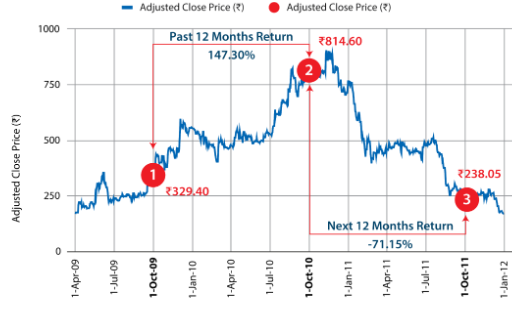
| Parameter | 30-Sep-08 | 30-Sep-09 | 30-Sep-10 |
| ROE | -23.28% | -51.65% | -30.76% |
| Debt to Equity Ratio | 306.33% | 772.30% | 837.19% |
| Current Ratio | 0.67 | 0.74 | 0.54 |
Source: NSE, CMIE, NJ Asset Management Private Limited Internal Research, NJ’s Smart Beta Platform (in-house proprietary model of NJAMC). For illustration purposes only. Stock prices are adjusted for corporate actions if any. The stock mentioned above is used as an illustration to explain momentum factor and should not be construed as advice/recommendation either to buy or sell. The stock may or may not form part of schemes' portfolios. Past performance may or may not be sustained in future and is not an indication of future return.
The Challenge for an Individual Investor
Understanding Momentum is one thing. Implementing it consistently is another. An investor trying to build a momentum portfolio independently would need to scan a large universe of stocks, assess their financial and business quality, identify momentum, monitor changes and periodically rebalance the portfolio.
And there is a behavioural challenge too. It is easy to stay confident when a strategy is working. The real test comes when it doesn't. If an investor enters after seeing strong returns and exits when the strategy temporarily underperforms, the investment process can quickly turn into performance chasing. This is where NJ AMC's rule-based approach becomes relevant.
From Stock Selection to a Systematic Approach
Instead of asking: Which stock should I buy? A rule-based approach starts with a more disciplined question: What does the process select? The difference matters.
NJ AMC follows a 100% rule-based, systematic and process-driven approach to investing, designed to reduce the influence of emotions, personal biases and market noise in investment decisions. For an investor, this means the focus shifts from individual stock calls to a defined investment process; one that uses predetermined rules to identify and select opportunities.
And this is where the approach becomes particularly relevant to Momentum Investing. Because when momentum is combined with a systematic quality filter, the process is not simply looking for stocks that are going up.
Quality First. Momentum Next.
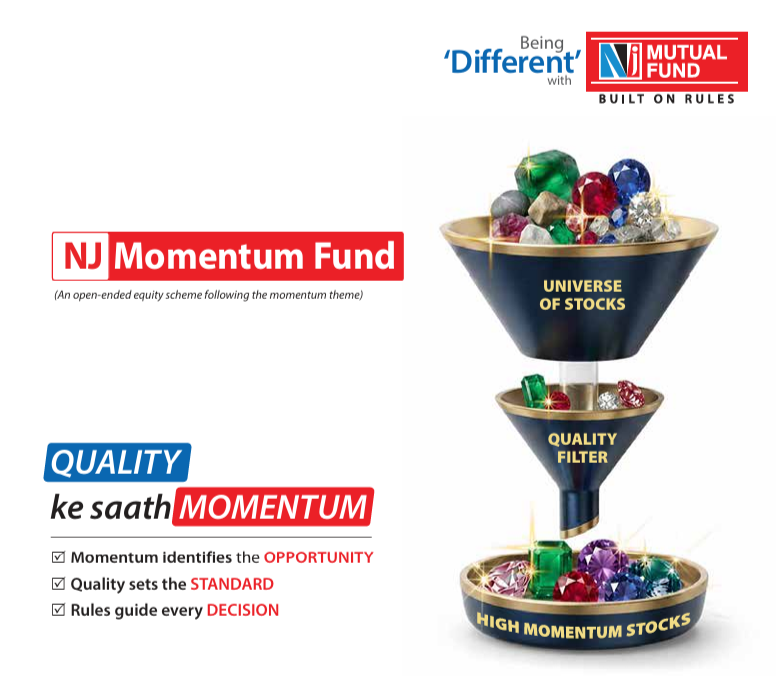
Momentum can help identify stocks showing strong price trends. But a rising price alone does not tell us everything about the business behind it. That is why NJ Momentum Fund combines a defined Quality Filter with Momentum Selection.
The process is simple:
- Quality sets the standard.
- Momentum identifies the opportunity.
- Rules bring discipline to the process.
This is the thought behind NJ Momentum Fund: Quality Ke Saath Momentum.
How Does the Strategy Work?
The methodology can be understood through a simple funnel.
-
Start with the Nifty 500
The process begins with the Nifty 500 universe, providing a broad pool of stocks for consideration.
-
Apply the Quality Filter
The universe is then filtered using defined quality parameters, including filters intended to eliminate low-quality, weak-forensic/governance and high-volatility stocks.
-
Look for Momentum
Once the quality filter has been applied, the process identifies stocks demonstrating strong momentum.
-
Build and Rebalance
The selected stocks form the portfolio, which is rebalanced quarterly.
Why Combine Quality and Momentum?
Think of a runner. Speed tells us how fast the runner is moving. But if we want to understand the runner better, we may also want to know about fitness, consistency and preparation.
In investing, Momentum looks at strength in price performance, while the Quality Filter looks at whether the stock meets defined quality standards.
Neither replaces the other. Together, they create a more structured way of approaching momentum. That is the essence of Quality with Momentum.
So, Who Does NJ Momentum Fund Suit?
This brings Rohan back to the most important question.
Not:
Has Momentum performed well? But: Is Momentum right for me?
Is NJ Momentum Fund Right For You?
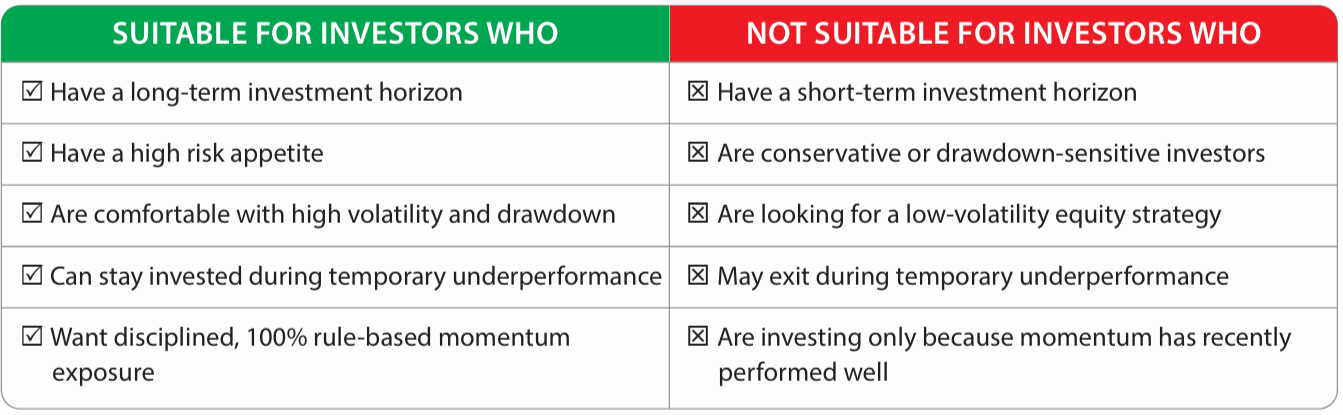
The suitability question is important because a good strategy is not necessarily the right strategy for every investor.
If this sounds like the kind of exposure you're looking for, talk to your financial advisor about whether NJ Momentum Fund fits into your portfolio, the right strategy is one that fits the investor's risk appetite, investment horizon and ability to stay invested.
Conclusion:
Rohan's original question was simple: The stock is already rising. Should I still buy it?
The answer isn't simply yes or no. Momentum investing is based on a clear market phenomenon; stocks showing strength may continue to show strength for a period of time. But momentum also comes with its own risks.
A rising price does not automatically mean a strong business. And trying to identify, monitor and rebalance momentum stocks independently can require considerable time, research and discipline.
This is where NJ Momentum Fund’s Quality with Momentum approach becomes relevant. Rather than simply chasing stocks that are going up, the approach begins with a quality filter, looks for strong momentum, and follows a defined, rule-based process.
Before You Consider Momentum
Before you consider the Momentum Factor, ask yourself:
- Do I have a long-term investment horizon (at least 5 years) and a high risk appetite?
- Am I comfortable with high volatility and sharp drawdowns?
- Can I stay invested through periods of underperformance, rather than exit early?
If the answer to all three is yes, NJ Momentum Fund may be suitable for you.
Because the most important question isn't always: What is moving? But rather: What meets the standard and can I stay invested for the journey?
FAQs:
Q) What is the Momentum Factor?
The Momentum Factor focuses on stocks that have shown strong recent performance and may continue to show strength.
Q) What are the key risks of Momentum Investing?
Momentum can reverse, leading to high volatility, sharp corrections and periods of underperformance.
Q) Why combine Quality with Momentum?
Quality helps set standards for the stocks considered, while Momentum helps identify stocks showing strength.
Q) How does NJ Momentum Fund select stocks?
It starts with the Nifty 500, applies a Baseline Quality Filter and then selects stocks with strong momentum.
Q) Who is NJ Momentum Fund suitable for?
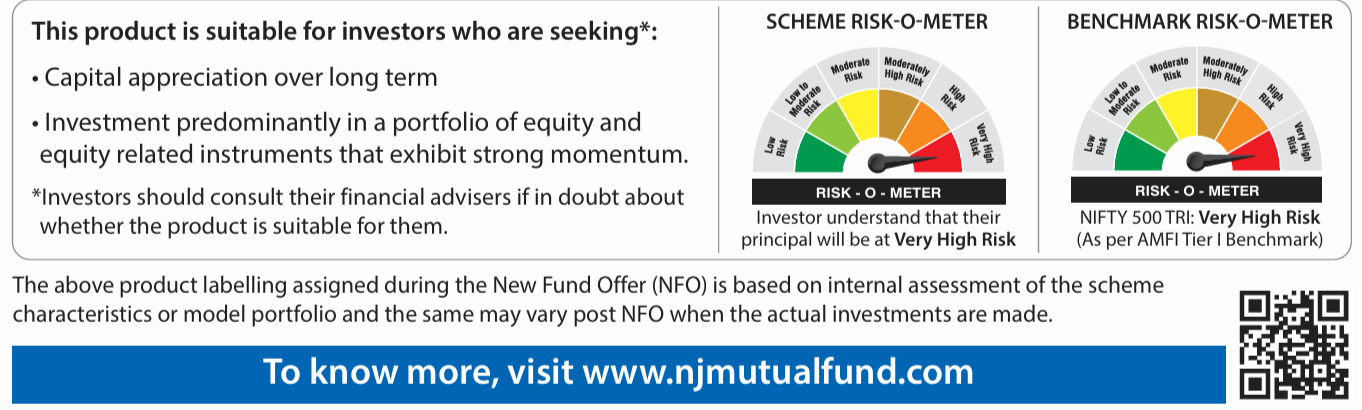
It is positioned for long-term investors with a high risk appetite who are comfortable with volatility and drawdowns.
SEBI Registered Name (Number): NJ Mutual Fund (MF/076/21/02) | Details of Other Regulatory Registrations: https://shorturl.at/SEBua
Investors are requested to take advice from their financial/ tax advisor before making an investment decision.
MUTUAL FUND INVESTMENTS ARE SUBJECT TO MARKET RISKS, READ ALL SCHEME RELATED DOCUMENTS CAREFULLY.
« Previous